End games
This week
- The president of the United States has now put his name on another’s monument, paved the Rose Garden, and demolished the East Wing of the White House for a ballroom. He’s planning an arch to rival the Arc de Triomphe in Paris. What is he trying to accomplish?
- What does the transformation of the German military mean for Europe? Liana Fix on Berlin’s mission to build the Continent’s most powerful army.
- What do you do if you’re the European Union, sitting on €200 billion belonging to the Kremlin? Sir William Browder on a potential turning point in the Ukraine war.
- What happened to the pro-democracy movement in Hong Kong? Glacier Kwong on Beijing’s political and security takeover of the enclave.
Weather report
- Two weeks of hard rain in the African South
+ Cultural intelligence
- How did India’s ruling party gain so much power? Atul Kohli and Kanta Murali’s new book, Democracy and Inequality in India: Political Economy of a Troubled Giant.
- How British is British R&B?
- & The week in new music
Developments
What’s happening? December 13-19.
Say my name
No sitting American president has ever put his own name on a national monument. The Washington Monument, the Lincoln Memorial, the Kennedy Center—such honors have always been posthumous tributes, conferred by successors and the U.S. Congress after their subjects had left office and, in most cases, this life. The norm was so implicit that it needed no enforcement: Presidents of the United States simply didn’t do this.
On Friday, workers on scissor lifts affixed metal lettering to the facade of the Kennedy Center in Washington. The building is now “The Donald J. Trump and the John F. Kennedy Memorial Center for the Performing Arts.” The signage went up one day after a board vote that Karoline Leavitt, the White House press secretary, called unanimous—though the 1964 act that established the center would require an act of Congress to rechristen it. As former Representative Joseph Kennedy III put it, the center “can no sooner be renamed than can someone rename the Lincoln Memorial.”
And yet. It caps a year of physical transformation unprecedented in Washington since the Truman administration gutted the White House in 1948. Trump paved the Rose Garden, replacing the lawn where presidents since Kennedy held ceremonies with white stone modeled on the patio at Mar-a-Lago. He demolished the East Wing—home to every first lady’s office since Eleanor Roosevelt—to build a US$400 million ballroom. He gilded the Oval Office ceiling, installed marble and gold fixtures in the Lincoln Bathroom, and lined the West Wing colonnade with presidential portraits in gold frames. This week, he added bronze plaques beneath each portrait, many of which he wrote himself, rating his predecessors. The plaque under Biden—represented not by a portrait but by an autopen signature—calls him “by far, the worst President in American History.” The plaque beneath Trump’s own portrait presumes what comes next: “The Presidential Walk of Fame will long live as a testament and tribute to the Greatness of America.”
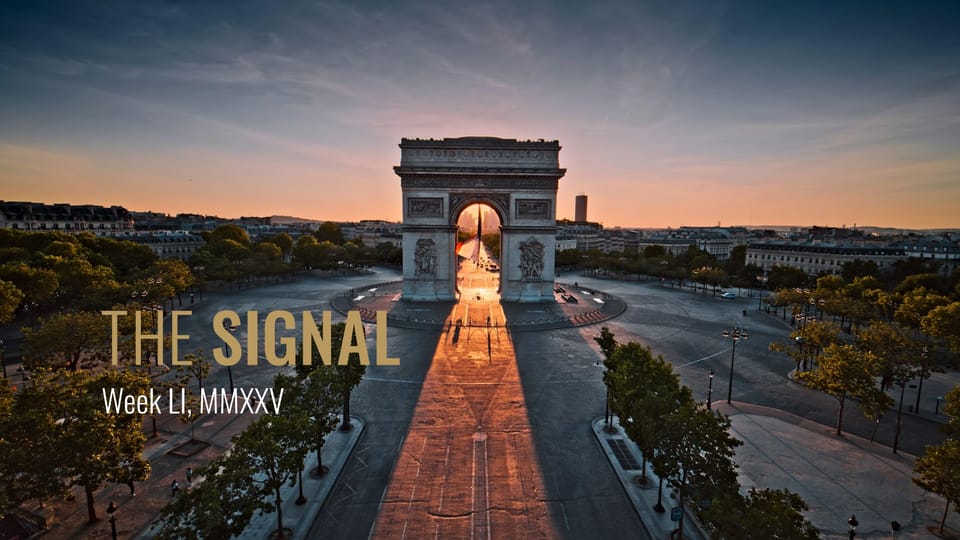
Then there’s the triumphal arch. In October, Trump unveiled plans for an “Independence Arch” at Memorial Circle, the traffic roundabout between Arlington National Cemetery and the Lincoln Memorial. The largest of three proposed designs would rival or exceed the height of the memorial it faces. Asked who the arch was for, Trump said: “Me. It’s going to be beautiful.” At a pre-Christmas gathering on Sunday, he confirmed that Domestic Policy Council head Vince Haley now oversees the project. “It will be like the one in Paris,” Trump said of the Arc de Triomphe. “But to be honest with you, it surpasses it. It blows it away in every way.”
These are not the moves of a president husbanding political capital or building coalitions for fights ahead. Paving Jackie Kennedy’s garden, demolishing the East Wing, writing partisan attacks on predecessors in bronze and mounting them on White House walls—none of this courts allies or defers to constituencies. Neither does chairing the Kennedy Center board yourself, or announcing plans for a monument to yourself while still in office.
But they’re also not obviously the moves of someone thinking about what happens next. Executive orders can be undone with a signature; a successor could rename the Gulf of America back to the Gulf of Mexico in an afternoon. The ballroom, should it go forward as planned, will outlast Trump’s term, but the plaques and much else could come down on January 21, 2029. Even the arch—if it’s ever built—would require years of approvals Trump won’t be around to shepherd.
A president building for posterity would pick battles that stick. A president indifferent to posterity, if there were such a thing, wouldn’t bother with monuments at all. Trump is doing something else: Moving fast, spending freely, putting his name on everything he can, with no apparent theory of what survives him—and no visible concern for the question.
Why?
- The constraints have largely disappeared. Trump isn’t running again. The Republican Party offers no meaningful resistance. Courts move slowly, and by the time they rule on the Kennedy Center’s name or the arch’s permits, construction may be finished or moot. The normal friction that makes presidents hesitate—the political cost of overreach, the threat of institutional pushback—isn’t functioning the way it used to. What we’re seeing may simply be what a president does when nothing stops him.
- Physical facts are harder to reverse than policy is. A successor can rescind an executive order with a signature. Renaming a mountain or a gulf costs nothing but attention. But the East Wing is already rubble. The Rose Garden is paved. The ballroom will be a 90,000-square-foot structure when it’s finished in 2028. Undoing these requires demolition, not paperwork—and demolition invites its own political costs. Trump may not be thinking about posterity, but he’s creating facts on the ground that his successors will have to actively undo rather than simply ignore.
- ‘Victories’ before results. There’s a fairly conspicuous pattern beyond the construction of physical monuments here: Trump announcing achievements before they’re secure. He announced a Gaza ceasefire in September; the first phase happened, the second hasn’t, while Israeli forces still hold half the territory. He’s been negotiating a Ukraine deal, now “closer than ever,” for months; the war continues. He lobbied openly for the Nobel Peace Prize; when it went to someone else, FIFA—the governing body of world soccer, not historically known for its moral authority—created a peace prize and gave it to him two weeks later. What seems to matter is having something nominal to point to.
The pattern is easier to describe than to explain. A president in his final term is moving faster than any predecessor to inscribe his name, his taste, and his judgments onto the physical and institutional landscape of the American government. He’s doing it without apparent concern for coalition-building, political sustainability, or the reversibility of his actions. And he’s doing it while his family takes in billions through business ventures that benefit directly from his administration’s policies.
A couple of interpretations might suggest themselves.
One: Trump knows exactly what he’s doing. Construction has inertia that executive orders don’t. A successor could tear down the ballroom, but would she? The political cost of actively demolishing a completed building exceeds the cost of leaving it there. Maybe Trump grasps this, and the building spree is strategic: create enough facts on the ground that reversal becomes costlier than acceptance.
Another: He’s not thinking about it at all. Trump has always wanted his name on buildings—that's been true since Trump Tower in 1983. He likes gold. He likes monuments. He likes making sure everyone knows he won. The Kennedy Center signage will almost certainly come down—but he wanted it up, and now it is. The presidency has removed the constraints that once required him to negotiate with partners, lenders, and city councils. Now no one can stop him. This isn’t strategy; it’s appetite, finally unrestrained.
These frames aren't mutually exclusive, either. A man who has always wanted his name on buildings might also understand, at 79, that time is short. Strategy and appetite can point in the same direction.
But the simplest explanation may also be the most disquieting. Trump is 79 years old, in his final term, surrounded by people who won’t tell him no. He can build what he wants, name what he wants, pardon whom he wants, and profit as he likes. The question of what endures may not interest him. The question of what he can do right now—that’s the one he’s answering, every day, in gold and marble and bronze.

Meanwhile
- The conviction of Jimmy Lai. A Hong Kong court convicted the publisher of the enclave’s most influential pro-democracy newspaper on grounds that could get him life in prison. He could have left Hong Kong when Beijing imposed its national-security law in 2020—but he stayed.
- Ninety percent there. The U.S. has offered Ukraine security guarantees it’s never offered before—but Russia’s position is still apparently defined by Putin’s declaration in June: “All of Ukraine is ours.” Now what?
- There is nothing to discuss. Putin addressed his Defense Ministry on Wednesday. His message: We’re going to take what we always wanted.
- While the president spoke. In a wide-ranging, 18-minute televised speech on Wednesday night, the American president happened not to mention Taiwan—or the $11 billion arms package the U.S. State Department was announcing at the same time.
- ‘What the heck is this?’ NASA’s James Webb Space Telescope this week revealed an exoplanet that defies every known model of planetary formation: a Jupiter-mass world orbiting a pulsar so closely that gravity stretches it into the shape of a lemon. Its atmosphere—helium and carbon, with soot clouds that may condense into diamonds at depth—looks like nothing astronomers have seen before. Its year lasts 7.8 hours.
Features
Dive deeper
Out of the past
What does the transformation of the German military mean for Europe? Liana Fix on Berlin’s mission to build the Continent’s most powerful army.