Smoke in the streets
Developments
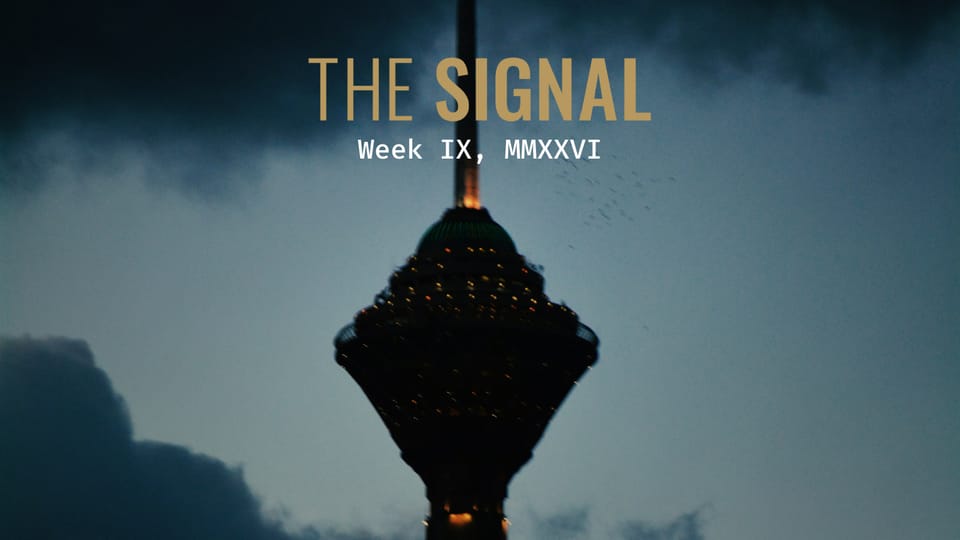
- Israeli and American strikes have killed the Islamic Republic’s supreme leader, his top commanders, and shattered the country’s military chain of command. The Revolutionary Guard is wounded—but still dangerous. And Iranians have poured into the streets. What now?
- Timing is everything. … Thrashing in Mexico. … & Fading in Cuba.
Features
- Why are so many countries rethinking their nuclear strategies? Serhii Plokhy on the emerging dangers of a new arms race.
- Why is Los Angeles’s entertainment industry in such crisis? Andrew deWaard on the shape-shifting effects of financialization and monopoly.
Books
- What held the post–World War II order together—and what’s coming apart? Daniel Bessner’s and Michael Brenes’s Cold War Liberalism: Power in a Time of Emergency.
Music
- Phonk?
- & New tracks from Diplo x 1nonly, Sofia Kourtesis x Novalima, Danny L. Harle x Caroline Polachek, Stereolab, & U2.
+ Weather report
- It’s heating up early across India and Pakistan, with the monsoons still months away …
Developments
Inside Iran
On Saturday morning, Israeli and American warplanes struck Tehran in broad daylight. Within hours, Iranian Supreme Leader Ali Khamenei was dead—killed in an airstrike on his compound, according to four Israeli security officials, as later confirmed by Iranian state media. Khamenei’s daughter, son-in-law, and grandchild died with him. Israel says its opening strikes targeted 30 senior military and civilian leaders; at least seven senior defense and intelligence officials died—Ali Shamkhani, a senior adviser to the supreme leader, among them.
But on the ground, a different scene. Iranians lit fireworks from their balconies. Young women climbed to rooftops to watch smoke rise from Khamenei’s compound and shouted for joy. People danced—an act the Islamic Republic criminalized in 1979. Female students in a Tehran school chanted “Death to Velayat,” the clerical system of government. Shops, cafés, and online businesses shut down in nationwide strikes.
This ground has been shifting for months. Since December, Iran has lived through its largest uprising since the 1979 revolution—protests triggered by the collapse of the rial and food inflation above 100 percent, which the regime met with a crackdown that killed thousands. The 40-day mourning memorials became political stages. University students burned Islamic Republic flags, waved the pre-revolutionary Lion and Sun, and chanted: “This is the final battle; Pahlavi will return.” The strikes landed on a country already in motion.
What’s happening in Iran?
- Built to outlast a man. Iran’s constitution anticipates a sudden loss of leadership. Article 111 provides for an interim council—the president, the head of the judiciary, and a senior cleric—to assume authority while the Assembly of Experts, a body of 88 Islamic clerics, selects a successor. When President Ebrahim Raisi died in a helicopter crash in 2024, the constitution absorbed the shock. Of course, Raisi was the president, not the supreme leader—no one has ever killed the man at the top—but the architects of the Islamic Republic at least designed it to survive this.
- But this was more than one man. Raisi’s death was an accident; the institutions were intact. Saturday’s strikes that killed Khamenei also targeted the institutional layer underneath him. Seven senior defense and intelligence officials are confirmed dead. Israel says it struck 30 top leaders in the opening salvo. Iran International reports that parts of the chain of command have broken down, with orders failing to transmit and some military commanders refusing to report to their bases. The Islamic Revolutionary Guard Corps (IRGC)—the elite military body that controls internal security, regional operations, and vast sectors of the Iranian economy—is reportedly pushing to appoint a new supreme leader outside the constitutional process, aiming for dawn on Sunday. If true, that may tell us something about the state of the formal procedures.
- A country already in motion. Before any bombs fell, university students had been forming associations calling for secular governance and free elections. Nationwide business strikes were already underway. The 40-day mourning ceremonies for January’s massacre victims had already turned into sites of coordinated political expression—parents dancing at graves, verses from the Shahnameh—Iran’s pre-Islamic national epic—replacing recitations from the Quran, crowds chanting for the return of the exiled crown prince, Reza Pahlavi. The Iranian opposition has momentum, symbols, and fury. It doesn’t have an organized political infrastructure inside the country capable of turning protest into governance. Pahlavi has been in exile for 47 years.
- The Revolutionary Guard. The IRGC answers—or answered—directly to the supreme leader. It’s wounded: The strikes disrupted its chain of command, several commanders are dead, and some personnel have apparently stopped reporting for duty. But it has deployed special forces across Tehran, and the pro-regime Basij paramilitary militia remains on the streets. The question of whether the IRGC fractures, consolidates, or does something nobody can yet predict may matter more than anything else happening in Iran right now. Nothing confirms widespread defections, though there are reports—unverifiable, so far—that some Corps members are looking for immunity.
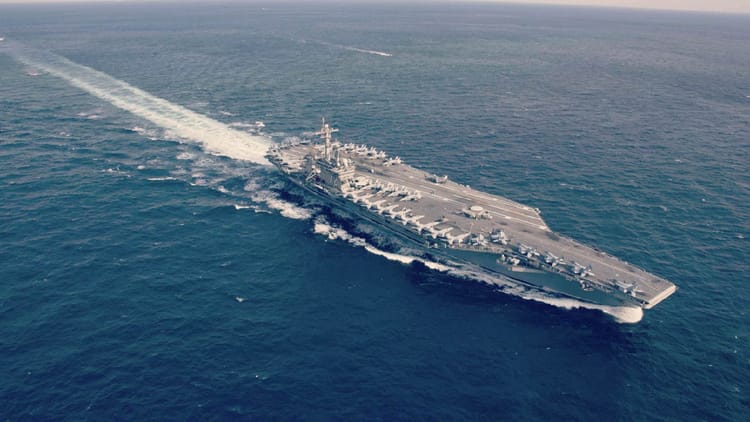
- The war is already regional. Iran retaliated within hours, launching missiles at Israel and at American military installations across the Persian Gulf—the Fifth Fleet headquarters in Bahrain, Al Udeid Air Base in Qatar, bases in Kuwait, the United Arab Emirates, Jordan, and Iraq. A senior Iranian official said “all American and Israeli interests in the Middle East have become a legitimate target” and that “there are no red lines.” One person died in Abu Dhabi from falling debris. A hotel on Dubai’s Palm Jumeirah, the luxury-resort island, sustained damage. The Gulf states appear not to have been given prior notice of the U.S.-Israeli operation. The U.A.E.’s senior diplomatic adviser said his country was “extremely dismayed” and did not “totally understand” how this war will develop. Iran’s Revolutionary Guard Navy warned vessels away from the Strait of Hormuz—which, it’s worth remembering, roughly 20 percent of the world’s traded oil passes through.
With Khamenei dead, Iran’s government has declared 40 days of national mourning—we’ll see how that goes—and across Tehran, people have been dancing. It’s hard to see what comes next.
One thing is clearly visible, though—and conspicuous: Iranians, across the country and around the world, are flying the Lion and Sun—Iran’s pre-revolutionary flag, a symbol of the monarchy banned since 1979. They’ve been flying it at university protests inside Iran, at the 40-day mourning ceremonies for January’s massacre victims, and at diaspora rallies in over 40 countries. We’re seeing it in the streets on Saturday night here in Washington, D.C.

Meanwhile
- Why now? The straightforward reasons line up clearly enough. A year of nuclear talks had gone nowhere. The International Atomic Energy Agency confirmed on February 27 that Iran’s near-weapons-grade uranium survived Israeli and American strikes on Iranian nuclear facilities last June, buried in a tunnel at Isfahan. The largest American military buildup since 2003 had already moved into position across the Persian Gulf. Israel’s Prime Minister Benjamin Netanyahu and, it turns out, Saudi Arabia’s Crown Prince Mohammed bin Salman, both privately urged U.S. President Donald Trump to strike. Iran’s regime, after months of protests and a crackdown that killed thousands, was at its weakest in decades. But the timing still raises questions: Trump has the Epstein files, collapsing polls, and a Congress starting to turn on him; and for one reason or another—or possibly several—his strategic timing happens to have shifted attention away from all of it.
- The wager in Jalisco. Last Sunday, Mexican special forces shot and killed Nemesio “El Mencho” Oseguera Cervantes, head of the Jalisco New Generation Cartel (CJNG), in a predawn mountain raid backed by American intelligence—reversing President Claudia Sheinbaum’s longstanding opposition to decapitation strikes. By Monday, CJNG had retaliated, torching buses, blocking roads in 20 states, and killing more than 70 people. El Mencho has no clear successor—and the Sinaloa Cartel, CJNG’s key rival, is splintering. Mexico will co-host the World Cup in four months. … See “Hugs and bullets.”
- An island going dark. On Wednesday, 10 Cuban exiles stole a speedboat from a Florida marina, crossed into Cuban waters wearing ballistic vests and carrying assault rifles, and opened fire on a border patrol a mile offshore. The raid was into a country that can barely function: Washington’s executive order cut off oil shipments from Venezuela and Mexico on January 29. And all nine of Cuba’s international airports have been without jet fuel since February 10. More than a million people have fled since 2021. … See “Running on empty.”

Wary of fast fashion?
Shop Congo Clothing Company and
make a difference—in style.
Features
‘The Chernobyl parameter’
Why are so many countries rethinking their nuclear strategies? Serhii Plokhy on the emerging dangers of a new arms race.