Productive conversations
Recently: Will Ukrainian democracy survive the Russian assault? Serhii Plokhy on the historical clues.
Today: Trump claims the U.S. is negotiating with Iran. Tehran says it isn’t. Suddenly, Iranian officials all seem to be bickering. … Italian voters reject the Italian government’s judicial reforms. … &c.
From the weekend despatch: Gas prices are up a dollar a gallon. Oil prices are up 58 percent. And the largest emergency oil release in history has hardly done anything. What is this war going to cost?
For members: A Category Four cyclone rams into one of the emptiest coastlines in Australia—threatening few people but a lot of cattle.
+ New music from Ora Cogan ...
Who talked
On Saturday evening, U.S. President Donald Trump gave Iran 48 hours to reopen the Strait of Hormuz or he’d “obliterate” its power plants. On Monday morning—two hours before U.S. markets opened—he posted that he’d had “productive conversations” with a senior Iranian official and was postponing strikes for five days. Oil plunged. Stocks rallied. Trump said Iran wants “very much to make a deal.” His envoys Jared Kushner and Steve Witkoff had spoken, he said, with “a top person”—“not the supreme leader. We have not heard from him.”
Iran denied everything. Mohammad Bagher Ghalibaf, the parliamentary speaker widely reported to be Trump’s unnamed interlocutor, wrote on X that no negotiations had taken place and that Trump was trying to “escape the quagmire.” The Foreign Ministry said the same. The American press largely treated the denial as the more credible account—Trump hyping a deal that didn’t exist.
Then something odd happened. Regime-linked accounts inside Iran began accusing officials of having secretly negotiated with Washington. Warnings circulated against the “character assassination” of Ghalibaf and former president Hassan Rouhani. Some called for arrests. As the journalist and activist Masih Alinejad documented on X, suspicion was spreading through the regime, and officials appeared to be turning on one another. Which isn’t typically what a fractured autocratic government does after nothing happened. As ever: Watch out for those narratives.
On Monday and Tuesday, U.S. and Israeli strikes hit central Tehran. Iran fired missiles into Tel Aviv.

Meanwhile
- Seeing the door in Beirut. Lebanon declared Iran’s ambassador, Mohammad Reza Sheibani, persona non grata on Tuesday—ordering him out by Sunday and recalling its own ambassador from Tehran. The move follows weeks of Lebanese government action against Iran and Hezbollah, whose March 2 rocket attacks on Israel dragged Lebanon back into war without Beirut’s consent. Hezbollah called the expulsion “reckless.” Hours later, an Iranian missile was intercepted over Lebanese airspace for the first time.
- The Italian premier’s first defeat. Italian voters rejected Prime Minister Giorgia Meloni’s judicial reform in a constitutional referendum on Monday—with nearly 54 percent voting no and turnout at an unexpectedly high 59 percent. The reform would have separated judges from prosecutors and restructured their oversight body; critics called it executive overreach. Meloni conceded but refused to resign. Analysts from across the political spectrum are calling it her first major setback—a year before parliamentary elections.
- Antiprotons for the autobahn. Arsonists set four Jewish volunteer ambulances ablaze outside a synagogue in London’s Golders Green; counterterror police are investigating a group with alleged Iran links. … Kim Jong-Un tells a state assembly the country’s nuclear status is “irreversible,” calling U.S. actions in Iran “state terrorism.” … His sister Kim Yo-Jong says no summit with Japan’s prime minister unless Tokyo drops its demand that North Korea return abducted Japanese citizens. … Pope Leo XIV calls for a ceasefire. … & The European particle physics laboratory CERN has transported 92 antiprotons by truck—the first time antimatter has traveled by road—suspended in a vacuum inside a one-tonne trap cooled to minus 269 Celsius. If anything had touched anything, it would have been annihilated.

AI will eliminate millions of jobs in the next five years. Yours doesn’t have to be one of them. Future-proof your career: Join the Superhuman AI newsletter, read by 1M+ professionals at the leading companies in tech and across sectors. Learn critical AI skills, in just three minutes a day—and become the AI expert on your team.
Developments
The price of a war
On February 27, a day before the United States and Israel initiated open war with Iran, a gallon of regular gasoline in America cost US$2.92. Brent crude—the global oil-price benchmark—was around $71 a barrel. More than 100 ships a day were passing through the Strait of Hormuz between Iran and Oman. The U.S. Energy Information Administration’s forecast for the year ahead projected the lowest annual average gas price since 2020.
That was more than three weeks ago.
Since then, the U.S. national average for a gallon of gas has climbed to $3.91—close to a full dollar higher. In California, it’s $5.62. In Arizona, it’s up $1.17. Diesel, which moves the trucks that move everything else, has jumped $1.39 to just over $5 a gallon. The Energy Information Administration says no four-week period in at least 30 years has seen a bigger increase—apart from Hurricane Katrina in 2005.
Brent crude has climbed 58 percent to roughly $112 a barrel. Traffic through the Strait of Hormuz has fallen more than 95 percent—from more than 100 ships a day to single digits. Gulf oil producers have collectively lost more than 10 million barrels a day of production. It’s the largest supply disruption in the history of the global oil market, per the International Energy Agency—the intergovernmental organization Western governments created in 1974 after Arab oil producers embargoed exports to the U.S. and its allies (in response to American support for Israel during the 1973 Arab-Israeli war). The IEA responded by releasing 400 million barrels of emergency oil reserves—more than double the amount released after Russia invaded Ukraine in 2022. The agency’s executive director called the disruption “the greatest global energy security challenge in history.”
Weather report
Cyclone Narelle crosses the Cape
10.6891° S, 142.5316° E
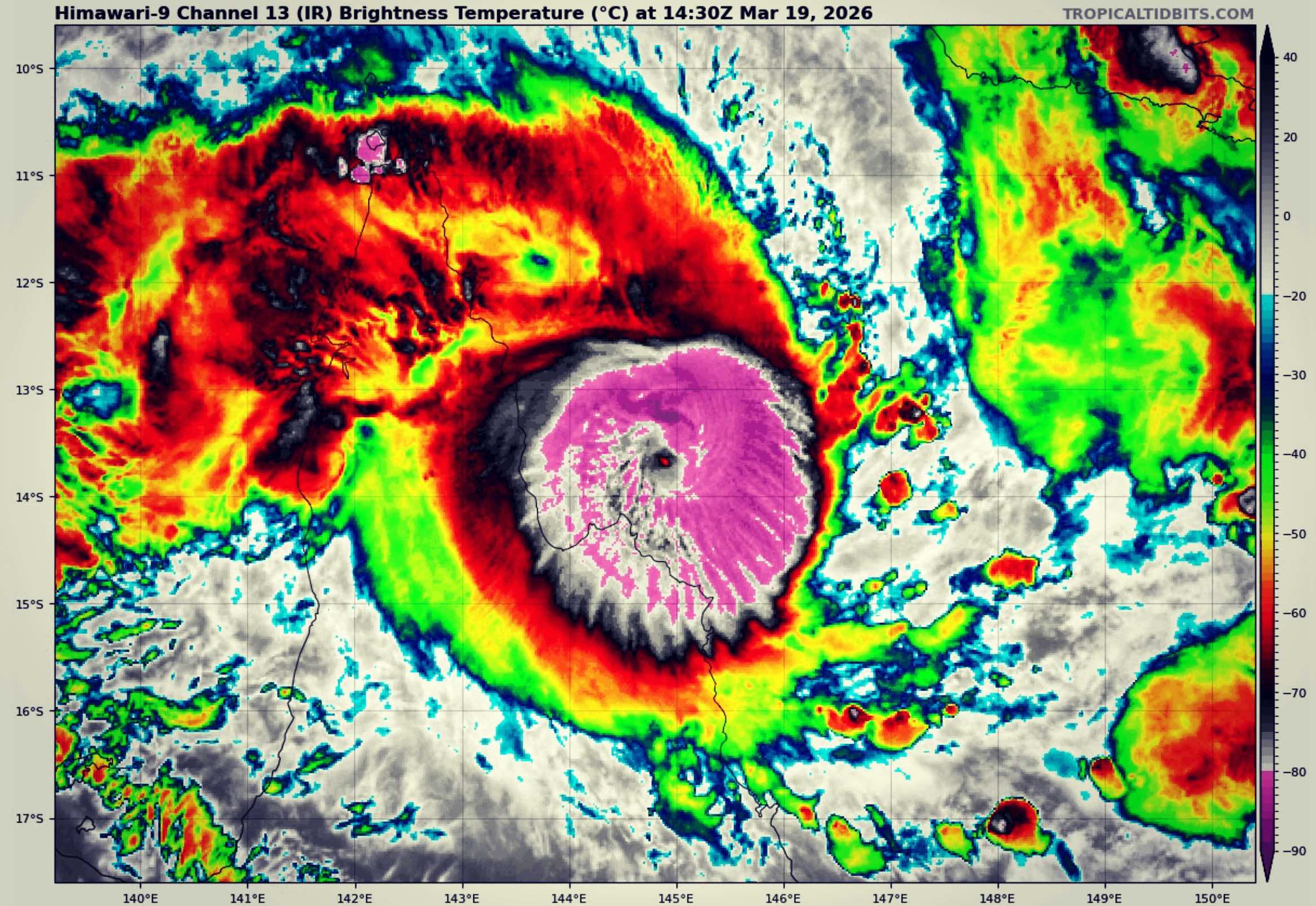
From the despatch: A Category Four cyclone rams into one of the emptiest coastlines in Australia—threatening few people but a lot of cattle …
Your loyal guide to a changing world.
Membership with The Signal means exclusive access to premium benefits:
* In-depth feature interviews with our network of contributors
* The despatch, our weekly current-affairs and cultural-intelligence briefing
* Early access to new products, including print extras
It also means vital support for a new, independent venture in current affairs.
New music
‘The Smoke’
Ora Cogan, the Canadian singer-songwriter, based in Nanaimo, B.C., lives in the borderlands of gothic Americana and folk. Most of the songs on her new album, Hard Hearted Woman, sound like spells—but this one: a haunting kind of folk rock.