
Destination Moon

Recently: Why did the Mexicans kill El Mencho? Benjamin Smith on the state losing control over the cartels.
Today: The American president tells allies to “just TAKE IT”—the Strait of Hormuz, the oil crisis, the whole thing. … People head to the Moon for the first time since 1972. … &c.
From the weekend despatch: Custom-built, jamming-resistant drones grounded nuclear bombers for a week in the middle of a war, with no explanation from the U.S. Air Force. What’s happening?
For members: Is it a heatwave if the heat never quits?
+ New music from Apparat ...
The hard part
On Tuesday, U.S. President Donald Trump told reporters in the Oval Office that the war in Iran would be over in two to three weeks. He said the United States had already achieved regime change. Secretary of State Marco Rubio listed four military objectives and told an interviewer to write them down—none mentioned Iran’s nuclear program, the reason Trump gave for starting the war on February 28. Defense Secretary Pete Hegseth said B-52 bombers were flying directly over Iranian territory. That same day, Iran struck a fully laden Kuwaiti oil tanker off the coast of Dubai. Drones hit fuel tanks at Kuwait International Airport. Missiles landed in Bahrain, Kuwait, and Qatar. The average price of gasoline in the United States crossed US$4 a gallon for the first time in nearly four years.
The Strait of Hormuz, which a fifth of the world’s oil supply normally passes through, remains effectively closed. The White House confirmed on Monday that reopening it isn’t among the military campaign’s core objectives. Trump told allies via his Truth Social platform to “build up some delayed courage, go to the Strait, and just TAKE IT.” On Wednesday, he told Britain’s Telegraph he was reconsidering U.S. membership in NATO.
In the meantime, Australia’s prime minister has urged citizens to take the bus. Oil executives continue to warn that if the strait doesn’t reopen by mid-April, the supply disruption will double—from five million barrels a day to ten. On Tuesday evening in D.C., Ebrahim Azizi, the head of Iran’s national-security commission, posted on X: “The Strait of Hormuz will certainly reopen, but not for you.”

Meanwhile
- Moscow goes dark. Russia’s monthlong mobile internet blackout reached central Moscow in March, and on Wednesday, the Kremlin’s expected full block of the messaging app Telegram—used by 90 million Russians—takes effect. Authorities cite drone defense; critics see a broader digital crackdown. Muscovites can’t hail taxis, pay by card, or use maps on their phones. Businesses in the capital lost an estimated one billion rubles a day. The state is pushing Max, a surveillance-friendly replacement that comes pre-installed on every device sold in Russia—but military commanders have banned soldiers from using it, citing security concerns.
- Fifty-three years and counting. NASA’s Artemis II mission is set to launch Wednesday evening from Kennedy Space Center in Florida—the first crewed flight beyond low Earth orbit since Apollo 17 in 1972. The 10-day lunar flyby will carry four astronauts, including Jeremy Hansen of the Canadian Space Agency, the first non-American to make the journey to the Moon. The crew will pass some 4,700 miles beyond its far side—farther from Earth than any human has ever traveled. Weather forecasts show an 80 percent chance of favorable conditions for the 6:24 p.m. ET launch window.
- His Majesty arrives. Trump signed an executive order directing the Postal Service to send mail ballots only to verified citizens—his second attempt to reshape election rules by decree. … The U.S. Supreme Court hears the administration’s challenge to birthright citizenship on Wednesday, with Trump in the courtroom—the first sitting president to attend oral arguments. … Serbian journalists blocked traffic outside President Aleksandar Vučić’s offices after pro-government supporters attacked reporters covering local elections. … The United Nations’ World Food Program cut rations for 1.2 million Rohingya refugees in Bangladesh to as little as US$7 a month. … King Charles III confirmed his first U.S. state visit as monarch—hours after Trump called NATO a “paper tiger.”

AI will eliminate millions of jobs in the next five years. Yours doesn’t have to be one of them. Future-proof your career: Join the Superhuman AI newsletter, read by 1M+ professionals at the leading companies in tech and across sectors. Learn critical AI skills, in just three minutes a day—and become the AI expert on your team.
Developments
Lights on
Custom-built, jamming-resistant drones grounded nuclear bombers for a week in the middle of a war, with no explanation from the U.S. Air Force. What’s happening?
Between March 9 and 15, waves of 12 to 15 drones flew over Barksdale Air Force Base in Bossier Parish, Louisiana—headquarters of Air Force Global Strike Command, which oversees every nuclear bomber and intercontinental ballistic missile in the American arsenal. The drones came in four-hour waves. They crossed over the flight line—the tarmac where aircraft are fueled, armed, and launched—where B-52H Stratofortresses, each capable of carrying nuclear cruise missiles, sit in the open. There are only 76 in the fleet.
A confidential briefing document dated March 15, reviewed by ABC News, described the drones as custom-built, not commercial products—equipped with long-range control links, sophisticated signal capabilities, and countermeasures that defeated the base’s electronic jamming. They flew with their lights on, which the briefing assessed as a deliberate choice: The operators may have been testing how Barksdale’s security forces would respond.
Every time a wave appeared, the Air Force grounded flight operations until the drones left. And all of it was happening during Operation Epic Fury, the American-led air campaign against Iran that began on February 28. B-52s from Barksdale were flying those missions—carrying bunker-buster bombs and stand-off cruise missiles, sometimes direct from Louisiana with eight mid-air refuelings. For a week, the drones came, and the bombers stayed on the ground.
Weather report
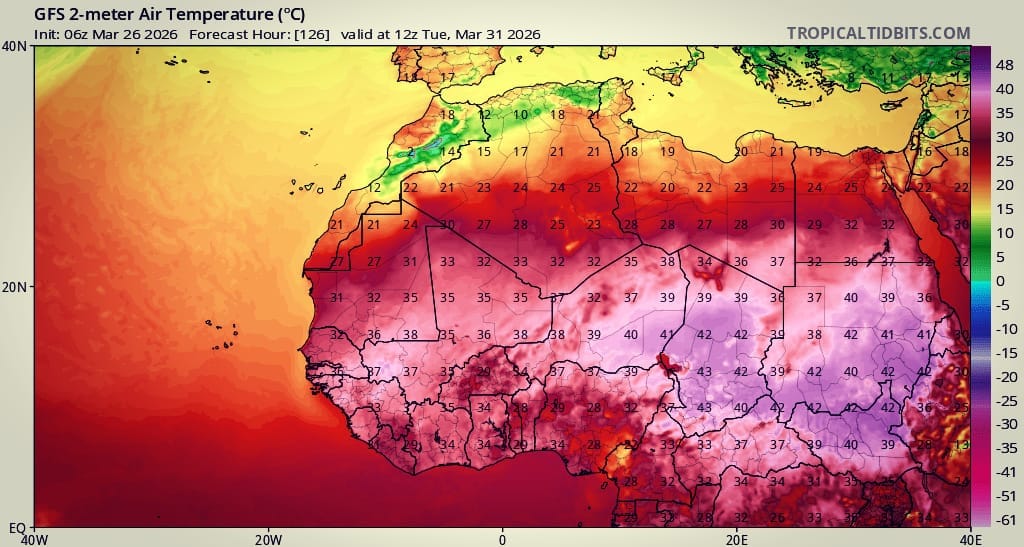
A heat that won’t break
16.9742° N, 7.9865° E
Your loyal guide to a changing world.
Membership with The Signal means exclusive access to premium benefits:
* In-depth feature interviews with our network of contributors
* The despatch, our weekly current-affairs and cultural-intelligence briefing
* Early access to new products, including print extras
It also means vital support for a new, independent venture in current affairs.
New music
‘Hum of Maybe’
If you hear a hesitance in the opening of this new single from Apparat—a.k.a., Sascha Ring—it soon gives way. Ring’s an electronic musician who’s moved from techno toward ambient in recent years, and if the German Aerospace Center ends up needing theme music, he might have created it for them here.