Whiplash

Recently: What is legal tender, anyway? J.W. Mason and Arjun Jayadev’s new book, Against Money.
Today: A ceasefire by evening that few saw coming at lunch. … The Taiwanese opposition joins the Chinese president in Beijing, while blocking American weapons in Taipei. … &c.
From the weekend despatch: Why back to the moon?
For members: Summer’s arriving early across northern India—and the atmosphere seems to be noticing.
+ New music from the Delvon Lamarr Organ Trio ...
Over what, exactly
On Monday, Iran sent its first formal counter-proposal for ending the war—10 points, delivered to Washington through Pakistani mediators after two weeks of internal deliberation. The proposal demands a permanent end to hostilities, a framework for safe passage through the Strait of Hormuz, reconstruction commitments, and the lifting of all sanctions. U.S. President Donald Trump called it “significant”—then rejected it, keeping his 8 p.m. Tuesday deadline in place: If Iran doesn’t reopen the Strait by then, he said, the United States will destroy every power plant and every major bridge in the country. On Truth Social, he wrote, “A whole civilization will die tonight, never to be brought back again.”
As of Tuesday evening, Trump has now accepted a two-week ceasefire brokered by Pakistan. Iran will open the Strait; Washington will pause strikes. U.S. Vice President J.D. Vance is expected to lead in-person negotiations. Israel’s Prime Minister Benjamin Netanyahu, along with the leaderships of Saudi Arabia and the United Arab Emirates, had urged Trump to hold out for major concessions; Vance and envoy Steve Witkoff pushed him to take the deal.
What is all this? Twelve hours separated the threat of civilizational destruction from a ceasefire. Iran’s demands—an end to hostilities, reconstruction, sanctions relief—are what any state would demand to end a war. A U.S. official called them “maximalist.” They are now the framework for talks. The International Monetary Fund confirmed on Tuesday that it will cut global growth forecasts; oil is above US$104 a barrel; shipping through the Strait has inched from near-zero to eight tankers a day, a fraction of prewar traffic. Tehran is apparently committed to reopening the Strait altogether, under its terms; Washington, six weeks in, still doesn’t seem to have settled on any.

Meanwhile
- Far from home. NASA’s Artemis II crew completed a seven-hour lunar flyby on Monday—the first crewed mission to the Moon since Apollo 17 in 1972—passing 4,067 miles above the surface and setting a new record: 252,756 miles from Earth, beating the mark Apollo 13 set in 1970. The crew photographed the far side, watched Earth set behind the lunar horizon, and witnessed a solar eclipse from deep space. Splashdown is on Friday.
- The opposition leader in Shanghai. Cheng Li-wun, the chair of Taiwan’s main opposition Kuomintang, arrived in China on Tuesday for a six-day visit at the invitation of Chinese President Xi Jinping—the first by a sitting KMT leader in nearly a decade. Back in Taipei, the KMT-controlled parliament is blocking a US$40 billion defense budget; ahead, a Trump-Xi summit in Beijing next month—when Taiwan is expected to dominate the agenda. The Taiwanese government describes the trip as an exercise orchestrated by Beijing.
- Rationing at Venice Marco Polo. An Israeli airstrike destroyed the Rafi-Nia Synagogue in central Tehran overnight, during Passover; the IDF says it was targeting an Iranian military commander in an adjacent building. … Gulf sovereign wealth funds are apparently reviewing U.S. investments, including AI data centers and the Paramount-Skydance-Warner Bros. merger . … Hungary votes on Sunday; U.S. Vice President J.D. Vance arrived in Budapest on Tuesday to shore up Viktor Orbán. … Three men drove from Izmit to Istanbul with long-barreled weapons, opened fire outside the building housing the Israeli consulate—unstaffed since 2023—and were stopped by police; one killed, two captured. … & Italian airports—Milan, Bologna, Venice, Treviso—are rationing jet fuel, capping aircraft at 2,000 litres each.

Dictatorships don’t collapse by accident. We dismantle them together.
High ground
A race to the south pole
Why back to the moon?
When Gene Cernan stepped off the surface of the Moon on December 14, 1972, he said he expected astronauts to return “not too long into the future.” In the more than half-century since, three presidential administrations tried to send Americans back, with either the U.S. Congress or the next administration canceling each program. George H.W. Bush proposed the Space Exploration Initiative in 1989; the Senate killed the funding. George W. Bush launched the Constellation program in 2004; Barack Obama’s administration canceled it in 2010, calling it “over budget, behind schedule, and lacking in innovation.” Obama redirected NASA toward Mars. And now, Donald Trump has redirected it back to the Moon.
Each post-Apollo program ended the same way: an ambitious presidential announcement, insufficient congressional funding, termination by Congress or a successor with different priorities. The democratic process—transitions, appropriations fights, shifting political attention—ended up serially and, it seemed, structurally incompatible with a project requiring decades of continuity.
Artemis is different. On Tuesday evening, four astronauts left Earth orbit for the first time since Cernan did—in a program that’s already cost US$93 billion without landing anyone on the lunar surface. Jared Isaacman, NASA’s administrator—and a billionaire entrepreneur who commanded two private SpaceX missions before taking the job—has restructured the program twice since December. The Artemis rocket costs about $4 billion a flight, a number the White House’s own budget proposal has called “grossly expensive.”
So why is Artemis different?
Weather report
Storm weather
28.7041° N, 77.1025° E
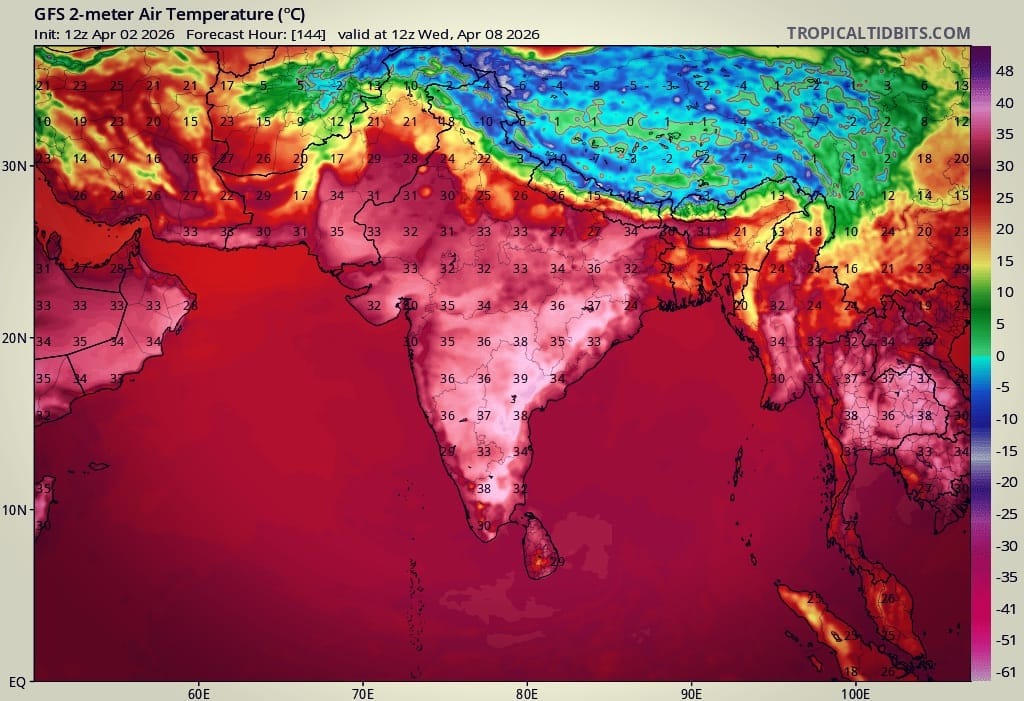
Heat from the south, cold air from the north—and a temperature gradient that will spark storms in the weeks ahead. That’s the picture across South and Central Asia next Wednesday afternoon, according to the U.S. Global Forecast System. Central Asia and Tibet are running several degrees below normal. India is not.
Your loyal guide to a changing world.
Membership with The Signal means exclusive access to premium benefits:
* In-depth feature interviews with our network of contributors
* The despatch, our weekly current-affairs and cultural-intelligence briefing
* Early access to new products, including print extras
It also means vital support for a new, independent venture in current affairs.
New music
‘Chicken Leg’
What worked for Booker T. & the M.G.’s in the 1960s lives again in the music of Seattle’s Delvon Lamarr Organ Trio today. Back then, the genre was just “instrumental R&B”; nowadays, it’s “soul jazz”—with DLO3 threading hip-hop through its beats.