Wanting to believe
Developments
- The U.S. government just opened a portal to its UFO files. But what are they actually releasing?
- Mamata Banerjee won’t concede defeat. … Donald Trump’s tariffs meet a second. … & The U.S. government reopens a case from the Apollo era.
Features
- Can you really switch off? Sara Robin on the growing resistance to addictive technology.
Books
- How did Washington get so corrupt? Andrew Cockburn’s Washington Is Burning: Corruption and Lies in the Age of Trump.
Music
- Who is Oneohtrix Point Never?
- & New tracks from him, Mei Semones, Boards of Canada, Carla dal Forno, & Fort Romeau.
+ Weather report
- Off the coast of Peru, a battery is starting to charge …
Developments
Disclosure, after a fashion
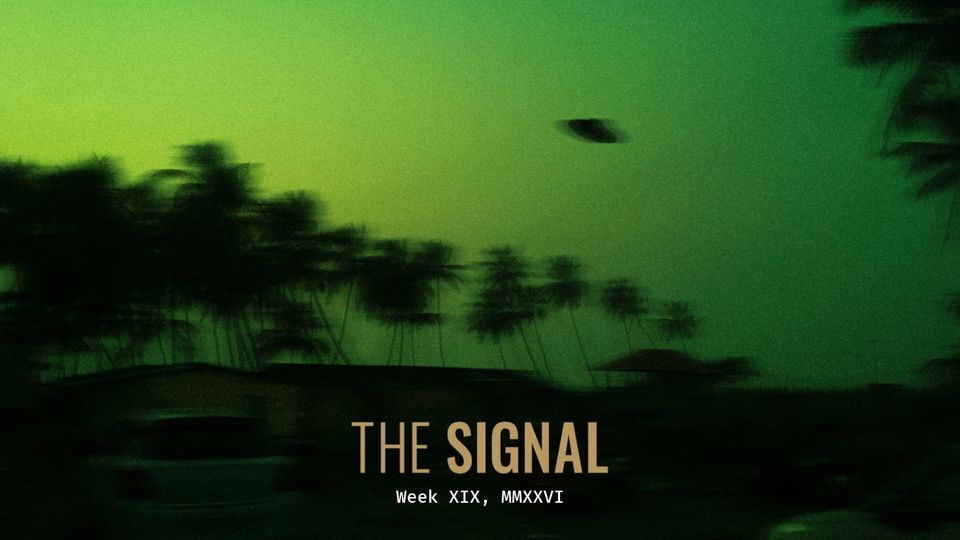
On Friday, the U.S. Department of War launched a public website—war.gov/UFO—and posted 162 previously classified records on what the American government now calls unidentified anomalous phenomena, or UAP. The files include roughly two dozen videos, totaling 41 minutes of military encounters between 2020 and 2026; archival photographs from the Apollo 12 and 17 missions; FBI reports going back to the late 1940s; and case files from the Pentagon, the Office of the Director of National Intelligence, NASA, and the Department of Energy. More tranches, the DoW says, will follow every few weeks.
The administration of President Donald Trump calls this project PURSUE—the Presidential Unsealing and Reporting System for UAP Encounters (confirming: “U” stands for “UAP”)—and describes it as a “whole-of-government effort” to provide “maximum transparency” on a question the federal bureaucracy has kept largely to itself since 1947. Trump posted on his social-media platform, Truth Social, that Americans can now finally “decide for themselves.” It’s the most extensive release of information on UAP in American history. It’s also a sliver of what the U.S. government holds.
So why this—and why now?
- The math of secrecy. The U.S. Central Intelligence Agency, the last time it released figures, withheld around 90 percent of its records; the Pentagon, around 75. Roughly six million Americans hold some form of security clearance. About 2,000 federal employees go through classified records for release. Material classified today should declassify automatically after 25 years; in practice, that takes 30, 40, or 50. The 162 files at war.gov/UFO open one corner of a regime that, as Matthew Connelly says here in The Signal, “is so vast that no one can keep track of it.”
- The office at the end of the hall. In 2022, the U.S. Congress created the All-Domain Anomaly Resolution Office, or AARO, to give American legislators a statutory window into UAP material. AARO has not yet released the second volume of its congressionally mandated report, nor its required 2025 annual report. PURSUE runs on a different track—a presidential portal the administration operates out of the Department of War (formerly the Department of Defense), modeled on the Justice Department’s release of the Epstein files in December. As Connelly puts it, the U.S. president “decides which U.S. officials can classify national-security information.” What the executive can classify, the executive can choose to release.
- What stays in the vault. The 162 files are case-level reports, redacted to protect “the identity of eyewitnesses, the location of government facilities, or potentially sensitive information about military sites.” What they’re not: They’re not any of the underlying intelligence assessments; they’re not the classification guides that determine what officials withhold; and they’re not records of programs that are public only because witnesses named them in congressional testimony—including the alleged “Immaculate Constellation” program, which in November 2024 the American journalist Michael Shellenberger described to Congress as a secret Pentagon initiative to collect classified UAP images and footage. The administration has not committed to delivering the AARO reports it owes Congress.
To understand PURSUE, we have to understand the system it belongs to. Connelly has been documenting that system for years, and his account of it is bracing: American secrecy began in earnest after World War II and has been expanding ever since: 18 intelligence agencies, including one inside the Space Force, and a classification apparatus so sprawling that even presidents who set out to map it can’t. “Nobody’s in charge,” Connelly says.
The Carter administration tried to rein it in and “couldn’t even figure out how many different programs there were.” Officials face career risk for letting classified material out and, in Connelly’s experience, none for classifying too much. The Joint Chiefs of Staff stopped keeping minutes of their meetings after Watergate, on the theory that records can leak; the most senior people in the Pentagon now run a US$800 billion department, Connelly notes, “as if it were some kind of numbers racket.” The basic mechanics of accountability—knowing what the government does in your name—rest on a declassification system that, as he puts it, has “no easy way out.”
PURSUE operates inside this system, not outside it. The administration has chosen which records to release, on what timeline, through which channels, with what redactions. It’s chosen to route the release through the Department of War rather than through AARO, the office Congress created for the purpose. Together, the choices show what disclosure looks like when the White House runs it on its own terms. Whether the rolling tranches inform the public or perform for it is a separate question.
The deeper question is Connelly’s: Can anyone outside a system this big, this old, and this opaque hold it accountable? It can offer a portal, a press release, and a steady flow of redacted documents; and it can call the result transparency. Which might be true, as far as the information goes. But the system yielding that information is still opaque—and can still produce its own appearance of transparency, as easily as it can withhold information. And the only people in a position to tell the difference are the people running it. … See “Need to know.”

Meanwhile
- A free bird. On Monday in India, the Hindu-nationalist Bharatiya Janata Party won 207 of 294 seats in West Bengal, ending Mamata Banerjee’s 15-year tenure as chief minister. Banerjee refused to concede. On Tuesday, she accused the Election Commission of bias, called the result a “dark chapter” in Indian democratic history, and declined to resign. “Let them dismiss me,” she told her party. On Thursday, the West Bengal governor dissolved the state assembly. Suvendu Adhikari, the BJP leader who defeated Banerjee in her home seat of Bhabanipur, is the likely new chief minister. … See “Modi strikes back.”
- The next statute. On Friday, the U.S. Department of Justice filed a notice of appeal of Thursday’s ruling against President Trump’s 10 percent global tariffs, sending the case to the U.S. Court of Appeals for the Federal Circuit. The Section 122 tariffs are set to expire in late July; it’s unclear whether the appeals court will rule in time to matter. The duties keep collecting in the meantime. Two tariff statutes have now failed the administration in court. Section 232 (national-security grounds) and Section 301 (unfair trade practices) remain on the table. Each comes with its own bounded authority. … See “Two laws, two losses.”
- Three dots over the Moon. Among the 162 records the U.S. Department of War published on Friday at war.gov/UFO is a December 1972 photograph from the Apollo 17 lunar mission. In the lower-right quadrant of the lunar sky, three small dots appear in a triangular formation. The image has been public for decades, but the government has now opened a formal investigation, obtained the original film, and reported that preliminary analysis suggests the feature is “potentially the result of a physical object in the scene.” The careful, hedged language is its own kind of disclosure: a federal bureaucracy, 54 years on, conceding it doesn’t really know what’s in the photograph. … See “Unclassified.”
Your reading list for a changing world
Browse The Signal’s bookshop—organized into collections that track key themes in our investigations of current affairs: what’s driving the information wars, why societies are fracturing, how power keeps reinventing itself. Contributors’ titles alongside books we've featured in our coverage.
Features
‘When the culture changes …’
Can you really switch off? Sara Robin on the growing resistance to addictive technology.