
‘There is no road’
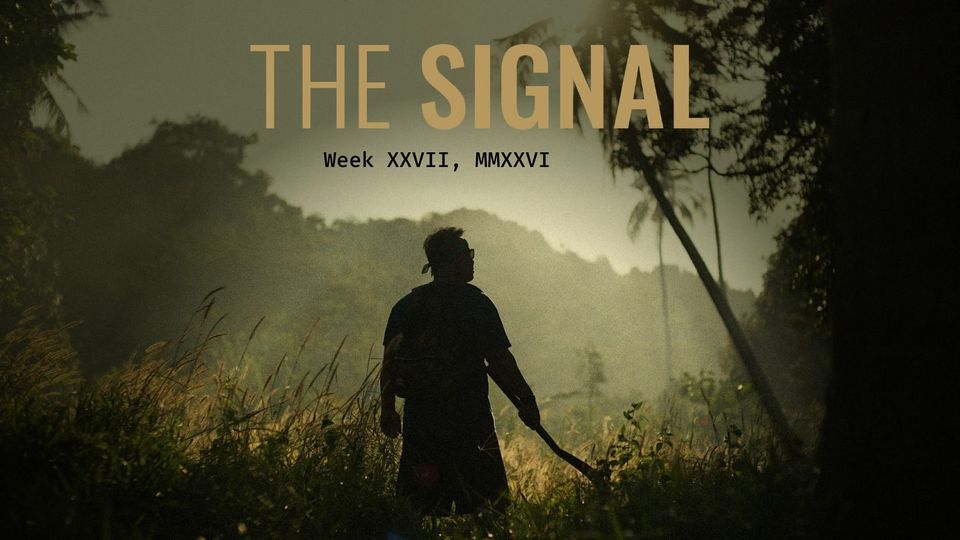
Developments
- Archaeologists have found Minanbé, a ruin lost in the jungle for more than 1,000 years. The question now is who gets to it first.
- In a new escalation, Afghanistan turns its drones on Pakistan. … North America’s trade pact is now up for renewal—every summer through 2036. … & A mystery at the heart of the Milky Way.
From the files
- What’s Pakistan getting from a war it can’t win? Anatol Lieven on how Afghanistan became a battleground again.
Features
- Why is Turkey’s government moving so hard to kill off its opposition? Ezgi Başaran on the weakness behind a new show of strength.
Books
- How far can an American president go? Richard W. Waterman, Constitutional Ambiguity and the Interpretation of Presidential Power.
Music
- What are Boards of Canada doing in hell?
- & New tracks from them, Tiga, Mike Campbell, LNRT, & Credit Electric.
+ Weather report
- In the Pacific, the super typhoon Bavi bears toward Guam …
Developments
As they left it
In late June, a team of archaeologists cut their way through dense jungle with machetes and chainsaws, then walked a final six kilometers to an undisturbed Maya city. There was no other way to get there, and never has been—which is why it was undisturbed: 15 hectares of plazas, palaces, and terraces, a 13-meter pyramid faced in finely cut stone, and 14 carved monuments, more or less as their makers left them some 1,100 years ago. Mexico’s National Institute of Anthropology and History announced the find this week. The team, led by the Slovenian archaeologist Ivan Šprajc, named the site Minanbé: “There is no road.”
Šprajc has worked the forests in Minanbé’s region of the country for three decades and logged more than 80 Maya sites, with this being the first his team has found intact in three years. They spotted it from the air with LiDAR technology—laser mapping that reads the ground straight through the jungle canopy. Minanbé is inside the Calakmul reserve, the largest stretch of tropical forest left in Mexico, where archaeologists have already recorded more than 500 sites.
Why now?
- From the air. Laser surveys flown over Calakmul have turned a green blank into a landscape crowded with plazas and pyramids; Minanbé first showed up as a cluster of too-regular shapes where the map held nothing. What once took a lifetime of walking, a plane now covers in a single dry season. The forest hides less than it used to.
- From the ground. Loggers and farmers are opening it from below. Illegal logging has pushed new tracks deep into the reserve, and farmers keep clearing its edges; a track cut for cattle or timber often runs right past a ruin. For now, archaeologists cut their own way in—while the loggers, from the other side, cut theirs.
- A complete record. Minanbé’s value is that it is whole. A city from the last century or two of Maya power, its carved monuments still standing where they were raised, is a rare chance to see how Maya civilization ended. One of those monuments is a stela—a tall inscribed stone the Maya raised to fix a date or honor a ruler. This one corresponds to AD 849—and was cut only decades before the Maya abandoned the region: By the 10th century, a population of once maybe 10 million had vanished; archaeologists still argue why—drought, war, exhausted soil. For centuries since, no one followed in Minanbé. And no people means no looters. Which is why it’s survived in the condition it’s in.
Which is, in turn, the problem now. Looters have always followed archaeologists, sometimes beating them to the spot. Every new site holds new loot to dig up and sell—carved stelae, jade, painted ceramics, panels a collector abroad will pay a fortune for. Where a road reaches a ruin, looters typically strip it within a season or two.
For decades, the sheer size of the reserve around Minanbé protected it—six kilometers of trackless forest, it turns out, keeps looters away better than any patrol could. But the loggers’ roads have pushed further in each year, LiDAR now yields exact coordinates, and buyers are waiting at the other end. The window between an archaeologist finding a site and a looter reaching it keeps narrowing.
For archaeologists to study Minanbé systematically—let alone for Mexican authorities eventually to protect it as a historical site—they’ll have to build a road to it. Theoretically, a road means risk, but it’s a risk they can mitigate with security—guarding the road and Minanbé itself—which is an imperative anyway, now that the cat’s out of the bag. What’s less clear is whether they can effectively guard the road to Minanbé along with the other 500 sites already discovered in this reserve—let alone the tens of thousands across the country. That Šprajc’s team hadn’t previously found an unlooted site in three years isn’t entirely encouraging.

Meanwhile
- The other direction. Late in June, Pakistan bombed what it called militant hideouts inside Afghanistan and kept killing civilians instead. This week, for the first time, Afghanistan struck back—its Taliban government sent drones into Pakistan’s Balochistan province. The Pakistanis say they shot down all four of the drones; the Afghans don’t dispute that—but insist the targets were enemy Islamic State cells inside Pakistan; and the Pakistanis say that’s not true at all—and that the drones are obviously intended to protect militants who’ve been crossing into Pakistan to kill soldiers and police for months. Hundreds have died on both sides since February. So far, talks meant to stop the fighting have gone nowhere. … See “Something must be done.”
- No rubber stamp. When the U.S. declined this week to renew its trade pact with its fellow FIFA World Cup hosts, Canada and Mexico, the sticking point was less the neighbors than a country that isn’t in the deal at all. Much of the review is aimed at China—specifically, at stopping Chinese firms from using Mexico as a tariff-free backdoor into the American market, a route that’s helped double the U.S. trade deficit with Mexico since the pact took effect. So to keep its access, Mexico may now have to curb the Chinese investment it spent years attracting. … See “Off autopilot.”
- The usual suspects. For more than a decade, astronomers have argued over a faint haze of gamma rays at the center of the Milky Way. Two suspects: 1) a hidden swarm of dead, fast-spinning stars, or 2) dark matter—the invisible mass that scientists have inferred, from gravitational patterns, makes up most of the universe but whose existence they’ve never been able to detect directly. Physicists at the University of Vienna and Lawrence Berkeley National Laboratory trained a machine-learning model to read the one set of clues earlier studies couldn’t—the energy of each gamma ray—and found that the first suspect would need to be composed of at least 35,000 stars, far more than they or anyone else can find. That doesn’t prove they’re looking at dark matter, but it does complicate the best reason to doubt it.

Can’t hear yourself think?
The David Lynch Foundation helps bring calm to veterans, students, and communities in need.
From the files
The enemy at hand
What’s Pakistan getting from a war it can’t win? Anatol Lieven on how Afghanistan became a battleground again.