A 10-day peace
Developments
- Given Washington and Tehran have apparently agreed a ceasefire, why is the United States … bombing Iran again?
- A defeated president in Bogotá still blames Israel for the vote he lost. … In Durban, thousands pack to go home by a deadline the government swears it never set. … & In Ankara, a scanner reads a 4,000-year-old letter straight through the clay that sealed it.
From the files
- What’s extreme heat do to you? Noah Diffenbaugh on the hidden costs of a warming world.
Features
- Has Iran ended America’s dominance in economic warfare? Nicholas Mulder on why the Americans can still squeeze their allies but not their rivals.
Books
- Why have the Qataris been betting so big on international mediation? Sansom Milton & Ghassan Elkahlout, Gulf to Global: The Rise of Qatar in Conflict Mediation.
Music
- How does FIFA end up with its World Cup anthems?
- & New tracks from Dubioza Kolektiv, The Avalanches x Jamie xx, Peter Gabriel, Hurry x Gerard Love, & Blood Orange.
+ Weather report
- In Europe—already two heatwaves into the summer, and it's only June …
Developments
Honored in the breach
Ten days ago, the war ended. At the Palace of Versailles, U.S. President Donald Trump signed a 14-point memorandum to end his country’s 100-day war with Iran, while in Tehran, Iran’s president, Masoud Pezeshkian, held up his own signed copy for the cameras. The deal lifted the U.S. naval blockade, reopened the Strait of Hormuz—the channel for roughly a fifth of the world’s seaborne oil—and called for the guns to fall silent on every front, southern Lebanon included. It entered into force on June 18.
The quiet lasted a week. On June 25, an Iranian one-way attack drone hit the Singapore-flagged tanker M/V Ever Lovely as it left the strait along the Omani coast; the next day, U.S. Central Command—CENTCOM, which runs American military operations across the Middle East—bombed Iranian missile and drone stores and coastal radar in reply, and Trump called the drone strike a “foolish violation” of his ceasefire. Over the weekend, a second tanker took an “unidentified projectile” to the bridge that UKMTO—the British navy’s maritime-trade desk in Dubai—couldn’t pin on anyone; its crew came through safe. Iran’s Revolutionary Guard said it had fired on American bases in Kuwait and Bahrain, and American jets struck Iran again on Saturday.
Now the blockade is lifted, and the strait is open, on paper—and the United States is still striking Iran.
So … is the war over, or …?
- The third gun. The memorandum is an agreement between Washington and Tehran, and Israel is not a party to it. All through the 10 days, Israeli jets kept striking Hezbollah across southern Lebanon, and it was those strikes the Revolutionary Guard named as the breach that freed it to fire on shipping—for which the United States then bombed Iran. A broker can sign for itself and lean on Tehran to sign alongside it, but it cannot sign for the ally that is still, by its own account, at war, and Israel has said it will keep hitting Iran’s militias in Iraq, Lebanon, and Yemen—whatever Washington puts its name to.
- Someone else’s water. The deal’s first promise was to reopen the Strait of Hormuz, but reopening it rests on Iran’s restraint rather than on America’s reach: A single drone shuts the strait again, the way one did to the Ever Lovely, and the tankers begin to reroute. Washington can lift its own blockade with a signature; it cannot make the water safe with one, because what makes the water dangerous has always been Iran’s to wield.
- Anonymous fire. Iran owned some of it—the Ever Lovely drone, the strikes on Kuwait and Bahrain—but it has not claimed the projectile that hit the tanker’s bridge on June 27, which UKMTO could log only as “unidentified.” In a waterway this crowded, where every party has reason to fire and as much reason to deny it, the unclaimed strike keeps the fighting going while leaving each side free to blame the other for the broken peace.
The collapse came fast, and not where the deal looked most fragile. Its hardest questions—enrichment, inspections, the size of Iran’s nuclear stockpile—had been pushed off to “further talks,” so they were never tested. What gave way instead was the part both sides had treated as already settled, the plain promise to stop shooting, and it gave way within nine days of the signing at Versailles.
The things that were actually America’s to give, it seems Trump gave—lifting the blockade, freeing Iran’s frozen funds, pledging the money to rebuild the country. What he could not give was also the one thing the deal needed most: an end to the shooting—because the war had never been America’s and Iran’s alone to end. Israel, which had no part in the memorandum—and by all accounts and appearances, no use for it—kept fighting. The Revolutionary Guard, whose hard line the war’s terms had just vindicated, had its own reasons to go on testing the strait. None of it was plausibly Trump’s to stop.
The rest of the deal is intact. It still promises US$300 billion to rebuild the country—though American jets are still bombing it. … See “Good faith.”

Meanwhile
- Proof, pending. On June 24, Colombia’s electoral authorities finished a recount and confirmed that the right-wing lawyer Abelardo de la Espriella had beaten the leftist senator Iván Cepeda by a single point. Cepeda conceded. Outgoing President Gustavo Petro, who had blamed Israel for hacking the vote, recognized the result too—then kept alleging fraud, with no proof his own attorney general could find. De la Espriella takes office on August 7. … See “Of all countries.”
- Not the first time. A South African citizens’ group, March and March, has told every undocumented foreigner to be gone by this coming Tuesday, June 30. President Cyril Ramaphosa’s government insists the thirtieth will be “a normal day,” even as it buses the migrants out itself—15,162 Malawians by June 25. Neither is any of this is particularly new. Attacks on foreigners killed 62 people in 2008, and the violence has returned in waves since—2015, 2019, 2021–22—each the work of a movement vowing to drive out the foreigner: Operation Dudula then, March and March now. … See “Out by Tuesday.”
- Read, unopened. Assyrian merchants at Kanesh, in central Anatolia, sealed their clay letters inside a second envelope stamped with the sender’s mark. You couldn’t read the letter without smashing the envelope, so museums left them unopened. Now the Assyriologist Cécile Michel and her team, reporting in NPJ Heritage Science, read the writing through the clay with a portable CT scanner in Ankara. One letter came from a woman, one Anna-anna, chasing a debt for her merchant husband, evidently losing patience as she waited for him to come home.
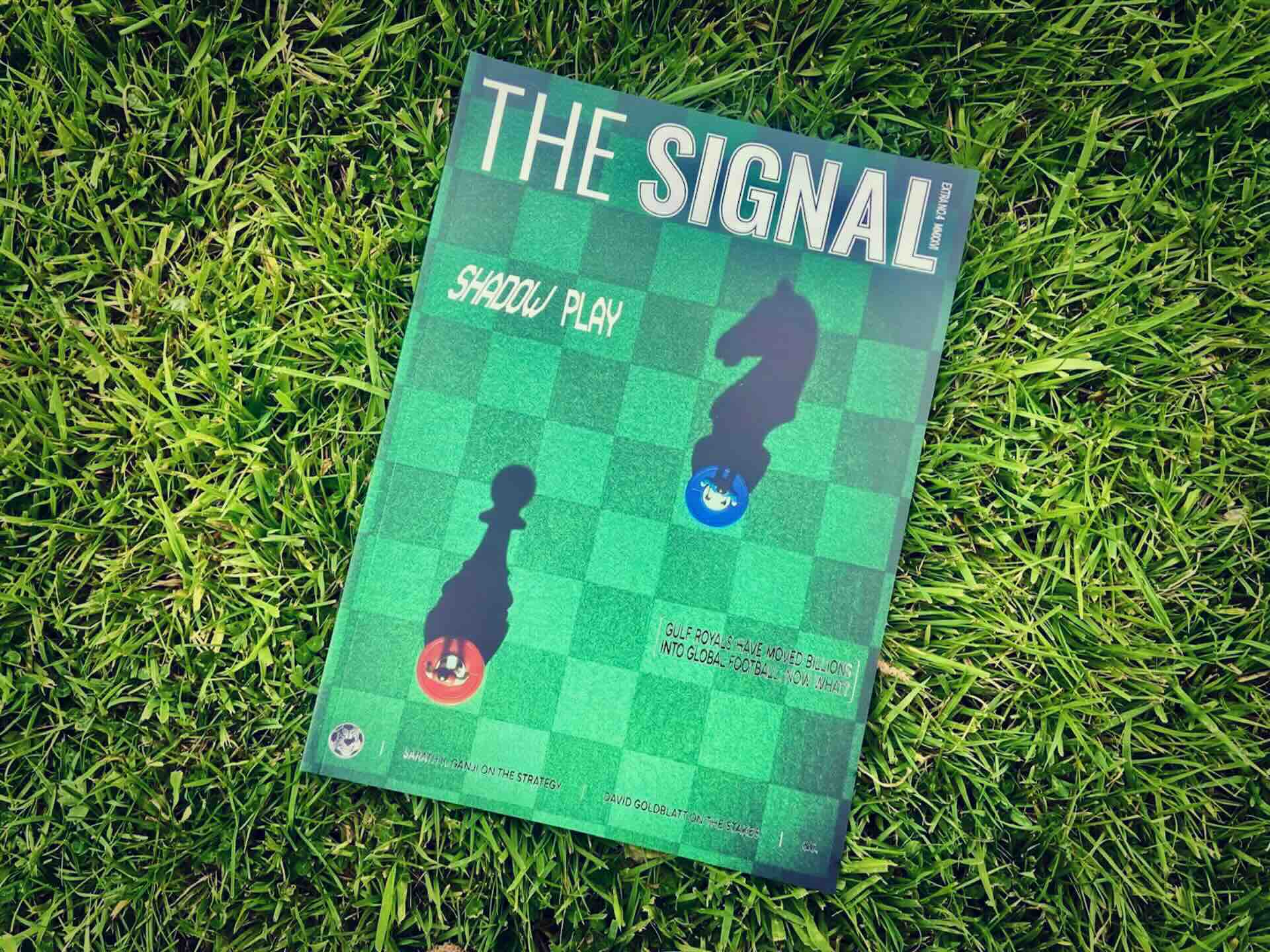
Gulf royals have moved billions into global football. Now what?
Read Shadow Play, a new, limited-run print magazine from The Signal.
On sale now in the U.S. and select markets globally.
From the files
Short fuse, slow mind
What’s extreme heat do to you? Noah Diffenbaugh on the hidden costs of a warming world.