Oil, oil, everywhere
Developments
- How has Russia, one of the world’s biggest producers of crude oil, wound up importing its fuel?
- Iran finally buries one ayatollah, with the next still in the shadows. … The Strait of Hormuz is empty again. … & Near Alexandria, archaeologists open 18 tombs sealed for 2,000 years.
From the files
- How much do America’s biggest media platforms really change people’s minds? Michael Socolow on the challenges and limits of billionaire influence.
Features
- Why is the U.S. government going so easy on white-collar crime? John C. Coffee Jr. on how the White House is making corruption safe again.
Books
- What happened to higher education? Chad Wellmon, After the University.
Music
- Are jazz tracks getting longer?
- & New tracks from SML, Ela Minus x Nick León, Phoebe Bridgers, PIGMNT, & Carly Rae Jepsen.
+ Weather report
- What happens in the Pacific, stays in the Caribbean …
Developments
Buyback
Russia is one of the biggest oil producers on earth. This month, it started buying gasoline—from India.
For most of the past three years, that would have made no sense. Russia sells its crude around the world—a lot of it, at a discount, to India—and refines plenty more at home into the gasoline and diesel that keep its cars and its army moving. It exports fuel; it doesn’t import it. And yet: This summer, Russian gasoline output has fallen by about a quarter; drivers across dozens of regions have been queuing for hours; and last week, Moscow banned diesel exports outright. A great exporter of fuel has been reduced, for now, to buying it—from its own number-one buyer.
Russia, of all countries, running short of petrol.
Why?
- The soft spot. It turns out there’s a difference between having oil and being able to use it. Russia’s crude sits in thousands of wells scattered across a country that spans eleven time zones, and no one can bomb their way through all of that. But to become diesel or gasoline, the crude has to pass through a refinery, and there are only so many of those—big plants that take years to build and can’t be quickly replaced. Since spring, Ukraine has flown long-range drones deep into Russian territory to hit them: at least 16 refineries in May, more in June, each strike reaching further inland. Crude processing has dropped to its lowest in two decades. So: Hit enough refineries, and it stops mattering how much crude your enemy has.
- What sanctions couldn’t do. This has done something three years of sanctions couldn’t. The West’s answer to the invasion of Ukraine was to go after the money the invader makes selling oil abroad, and Russia mostly shrugged it off—finding new buyers in India and China, moving its crude on a “shadow fleet” of hard-to-trace tankers, keeping the cash coming. Ukraine’s drones don’t bother with the money. They go after the fuel Russia burns instead of the oil it sells—the diesel and gasoline its army and its economy both run on.
- India’s cut. When the West stopped taking Russian crude, India stepped in, buying it cheap, refining it, and selling the fuel on. Now Moscow is one of its customers, importing Indian gasoline to cover a shortfall of about a fifth of what the country burns. India makes money at both ends—buying the crude at a discount from a seller with few other options and selling the fuel back at the going rate. Russia has no shortage of oil; it just has a shortage of leverage over the guys it has to buy from.
None of this means Russia is about to run dry. It still has fuel, still has the crude, and the export ban keeps more of what it does refine at home; Moscow calls the shortages temporary and blames panic-buying. The deputy prime minister, Alexander Novak, announced the ban on state television, seated beside President Vladimir Putin, and described it as a routine step to “increase supplies to the domestic market.” Putin said Ukraine was only trying to spread anxiety, and that it would fail.
But the queues aren't from anxiety; they're from a lack of gas. The refineries are still burning. For three years, the front in eastern Ukraine barely moved, despite all the sanctions out of Washington and Brussels. The drones over its refineries have done more than either—deep inside Russia, far from the front.
For now, it seems there’s a new race: Ukraine has to burn refineries faster than Russia can repair and defend them; Russia has to keep the imports coming and hope the shortage doesn’t reach the front. Neither side is ahead yet, but the drones have the edge: A refinery takes months to rebuild, it can’t be moved, and Ukraine has already hit them thousands of kilometers inside Russia. Those strikes will keep coming—Russia can count on it. Which is what Ukraine appears to be counting on in turn.

Meanwhile
- A leader on paper. Iran buried Ali Khamenei on Friday in Mashhad, four months after the strike that killed him. His son Mojtaba Khamenei, named supreme leader in March, did not attend. No one outside the leadership seems to have seen or even heard him since the war began, while the leadership itself says young Khamenei is still recovering from his wounds. Four months in, all Iran has seen of its new supreme leader is his signature. Or what appears to be his signature. … See “In his absence.”
- Still water. After the U.S. called off the June ceasefire this week and went back to hitting Iran's coast, shipping through the American-escorted lane dropped close to zero by July 10, down from around 88 large vessels a day before the war. Both sides want to control Hormuz and charge for passage. For now, there’s almost nothing to charge for. … See “The trains to Mashhad.”
- To speak with the gods. On Egypt’s Mediterranean coast, west of Alexandria, at a Greco-Roman town the ancients called Leukaspis, archaeologists have opened 18 tombs from the Ptolemaic and Roman centuries. Alongside the usual grave goods—clay lamps, wine jars, a granite sarcophagus two and a half meters long with its occupant still inside—they found two dozen thin leaves of gold, each laid on the tongue of the dead. It was a known rite of the Hellenistic and Roman world: a “golden tongue,” placed in the mouth so the dead could plead their case before the gods of the underworld. Two thousand years later, the golden tongues are still there.

Gulf royals have moved billions into global football. Now what?
Read Shadow Play, a new, limited-run print magazine from The Signal.
On sale now in the U.S. and select markets globally.
From the files
The reach illusion
How much do America’s biggest media platforms really change people’s minds? Michael Socolow on the challenges and limits of billionaire influence.
Features
‘Someone knew, and someone was trading’
Why is the U.S. government going so easy on white-collar crime? John C. Coffee Jr. on how the White House is making corruption safe again.
Books
‘The kind of citizens our country needs’
What happened to higher education? Chad Wellmon, After the University.
On July 1, a new rule from the U.S. Department of Education took effect that will judge American colleges by a single measure: how much their graduates earn. Programs whose graduates fail to out-earn workers who never enrolled stand to lose access to federal student loans, and schools where such programs dominate could lose their federal aid altogether.
It’s a blunt answer to a question universities have long preferred to leave open—what a degree is for—and it lands as public faith in them is collapsing. About 70 percent of Americans now think higher education is headed the wrong way; a decade ago, 57 percent expressed a great deal or quite a lot of confidence in it, and by 2024 that had fallen to 36 percent, a historic low.
Here in The Signal, the Yale sociologist Julia Adams and the legal scholar Sarath Sanga trace the collapse to the university’s own drift. The top three reasons, Sanga says, are “cost, cost, and cost”—tuition on a runaway train while the worth of a degree slides. But under the grievances lies something harder to fix: universities have taken on so much—Adams points to an “explosion of student-run extracurricular organizations,” a secondary curriculum crowding out the first—that they’ve lost their grip on what they’re for. No one chose the runaway train, Sanga says; the university just “didn’t have a governance structure that stopped it.”
So why not?
In After the University, Chad Wellmon explores the history of the relationship between higher learning and the institutions that claim to protect and promote it.
Although some universities trace their origins back to the Middle Ages, the modern research university really only goes back two centuries, to the Prussian institutes of higher learning.
In the early twentieth century, the new American research universities reinvented themselves—they vastly expanded in size and subsumed the old classical colleges. In the 1920s and 1930s, for instance, Yale and Harvard created their residential house and college systems; the idea of “college life” now became central to the idea of the American university, with student fraternities and sports clubs proliferating.
As the German sociologist Max Weber observed when he visited the United States in 1904, the American campus had begun to reflect the professionalization of wider American society. Here lies the root of the peculiar American obsession with one’s college belonging—American elites, Weber noted, recognize each other by the colleges they went to. “The spectacle of each new campus craze kept America’s cultural elite attached to alma mater,” Wellmon writes.
This was when the universities introduced much of the bureaucracy that has by now become so bloated. These bureaucrats were on hand not solely to make life easier for professors but to socialize the students—university leaders, Wellmon writes, saw themselves as engaged in the “management of moral lives.”
(Universities—but really university bureaucrats more so than professors—therefore get swept up in moral panics from time to time, Wellmon notes: It has always been their task to ensure “community safety” or whatever the going euphemism is.)
“It may be that we do not teach our students anything. But that isn’t our purpose,” University of Chicago president Robert Hutchins said in 1936. “Our purpose is to turn out well-tubbed young Americans who know how to behave in the American environment. Association with one another, with gentlemanly professors, in beautiful buildings will, along with regular exercise, make our students the kind of citizens our country needs.”
With the basic campus infrastructure in place, American universities responded to the massive postwar influx of new students—who in the 1960s proved themselves unruly, with radical protests sweeping the country—by seeking to mollify them. If factory workers could exert pressure on management through unions, students—who’d be gone from campus in a few years—could be pacified by treating them “as atomized consumers rather than as students to be educated.”
Universities thus began building new student halls, which they put under the oversight of student offices, constructed sports facilities, established career counseling services, and much besides.
Over time, this has produced what Wellmon calls the current “morass of bureaucracy, regulations, and rules that manages students—largely detached from what happens inside classrooms and labs.” This bureaucratic bloat, he emphasizes, “is not an alien entity that corrupted an otherwise healthy institution.” Rather, it emerged from the “reorganization of universities into a system of higher education” that took place from 1950 to 1970.
“People are driven toward the university not because they want to learn, but rather because they know that the road to a good life runs through the university.” Prussian bureaucrats, Wellmon notes, made that observation already in the nineteenth century. As such, universities have long “provided refuge, material support, and institutional legitimacy for intellectual work, while simultaneously constraining and distorting it.” Distortions may be more or less injurious, but there’s no way of fully warding off pure intellectual work from the “morass of bureaucracy.”
Wellmon believes that the willingness to face the fact that “credentialing is the university’s primary social function” while simultaneously insisting that the university’s true purpose is to create and share knowledge has “fostered the delusion that the fate of higher learning depends on the university.” Not so, Wellmon says. The university is valuable. Disciplined study, however, oughtn’t be confined to it.
Music
‘Roundabouts’
SML, the Los Angeles jazz outfit, is back with a new record, Spontaneous Music Live, and unlike the group’s previous records, this one isn’t chopped and mixed; it’s two long cuts—one on Side A, one on Side B. This track develops over some 24 minutes, moving in geological time. You won’t hear solo after solo—but the sound of a tight unit in a deep groove.
Twenty-four minutes, though?
In Los Angeles, there are signs of a trend back toward more extended tracks. First, Jeff Parker and his ETA IVtet released Happy Today on May 15, with one piece on Side A and one on Side B, recorded live at the Lodge Room. More recently, SML released Spontaneous Music Live on June 26—a 48-minute live album of two unedited improvisational tracks, recorded at the L.A. venue Zebulon in December 2025.
Two members of SML also play with Parker in his ETA IVtet: bassist Anna Butterss and saxophonist Josh Johnson. And the same engineer, Bryce Gonzales, recorded both records. Could be these two took the idea from Parker, grabbed Gonzales, and headed to Zebulon.
If you’re working, reading, or cooking, a 24-minute piece that unfolds slowly might be more satisfying, in its way, than six separate tunes. It may also be a form fit for vinyl—where one uninterrupted side is almost a natural musical unit.
Both records, either way, are from players who grew up on influences as varied as Brian Eno, Can, Fela Kuti, Miles Davis—and will bring any of them forward, apparently without a second thought involved. You can hear that in “Roundabouts”: It doesn't sound like “jazz fusion” in the old 1960s and ’70s sense; it sounds like music that’s absorbed 50 years of evolution and considers it all implicitly normal.
‘Espiral’
Here we have a pairing of the Colombian synthpop royal Ela Minus with the Miami DJ and producer Nick León—out with a new EP, Qué les Pasó a Mis Amigos? (In English, What happened to my friends?) A note of despair that vanishes in the music.
‘Lost Boys’
Next stop, Los Angeles, for the return of Phoebe Bridgers. The singer-songwriter has kept good company—Boygenius, Better Oblivion Community Center—but her last proper solo record, Punisher, was six years ago. Good news: Lost Weekend comes out August 14.
‘Suma Root’
PIGMNT is a London DJ and producer who works in a set of hyperspecific genres: U.K. funky, South African gqom, and the strain of house called tribal. It’s fast, drum-heavy music built for the floor.
‘On Wires’
Onward to British Columbia, Canada: Carly Rae Jepsen has a 24-track double album, Day and Night, due out September 18—half the songs warm and guitar-based, the other half cooler and electronic. “On Wires” is among the first, with staccato piano and a big, belting chorus. Jepsen shot the video while six months pregnant; she wanted initially for it to show her chasing a man through New York City—but, she says, she figured “it would look like I’m looking for child support.”
Weather report
Warm sea there, dry land here
18.466333° N, -66.105721° W
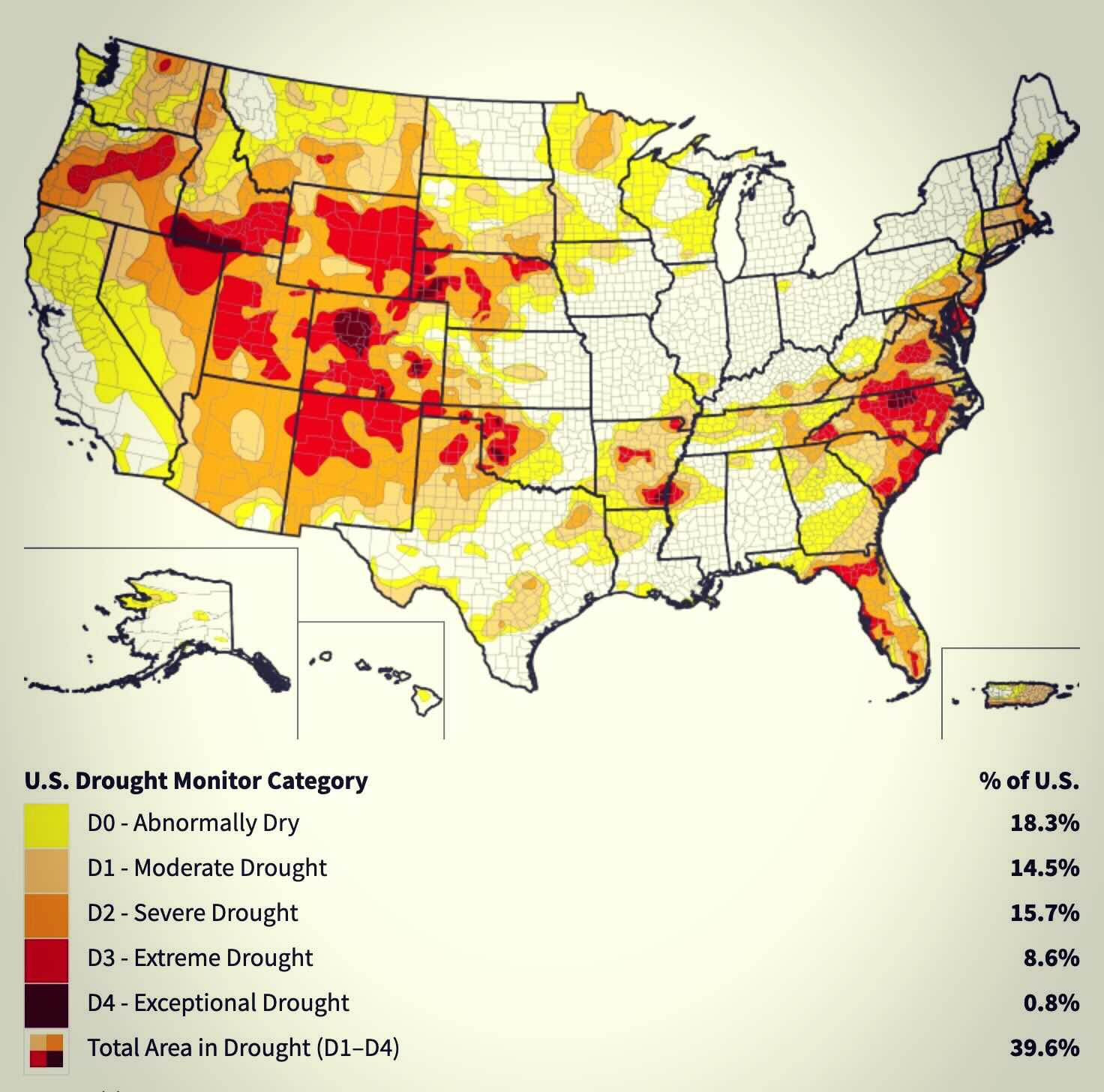
El Niño—the periodic warming of the tropical Pacific that shifts weather patterns worldwide—is here. The U.S. Climate Prediction Center has an advisory in effect, and expects these warm conditions to strengthen through year's end and very likely last into early 2027. And it’s already in the Caribbean—in Puerto Rico.
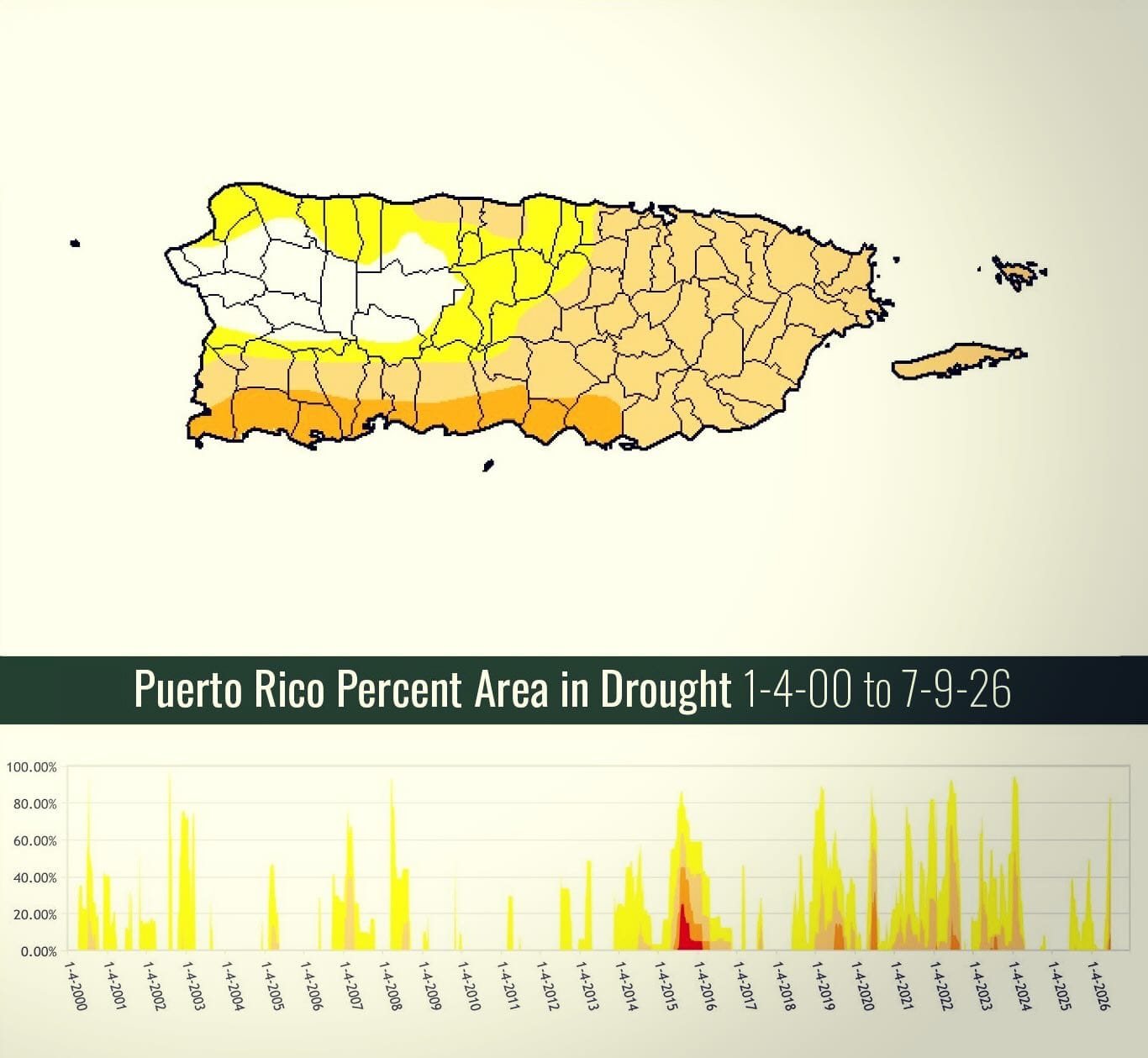
There, a relatively dry season runs from around December into April, followed by a wetter stretch that usually starts in late spring and carries through hurricane season. By early July, a lot of tropical showers and thunderstorms would normally be soaking the ground. This summer, they aren’t. Instead, the U.S. Drought Monitor shows moderate drought jumping from 40.9 to 61.4 percent of the island in a single week, and severe drought nearly doubling—from 5.9 to 10.5 percent. That’s a dry spell taking hold, not ordinary seasonal variation.
For Puerto Rico, El Niño tends to mean fewer easterly trade-wind showers, less tropical moisture, a delayed or weaker wet season, and higher drought risk through summer and autumn. Not every El Niño brings severe drought to the island, but it tilts the odds that way. On the Puerto Rico map above, that’s what you’re seeing.
The continental map up top looks different—not a national drought emergency, but a set of regional droughts that have persisted for months: the Mountain West, the Mid-Atlantic and the Carolinas, and Florida. The Midwest and the lower Mississippi Valley seem much better. In the West, drought has become almost “background climate” over the years. In the East, the dry pockets have lingered because the rain hasn’t soaked in enough to erase long-term moisture deficits, even when storms pass through.
In Puerto Rico and the Caribbean, drought could deepen if a subdued hurricane season keeps tropical moisture down. Other places to watch as El Niño strengthens: Central America, which often runs into serious agricultural drought in El Niño years; and the Pacific Northwest and northern Rockies, where a strong El Niño could mean less snow than usual up in the mountains this winter.
Be in touch: concierge@thesgnl.com.