‘A good man fundamentally’

Recently: Can you really switch off? Sara Robin on the growing resistance to addictive technology. ... & The U.S. government opened a portal to its UFO files on Friday. But what are they actually releasing?
Today: What’s driving the rebellion against the prime minister of the United Kingdom? … A senator wanted for crimes against humanity refuses to leave his office in the Philippines. … &c.
For members: How did Washington get so corrupt? Andrew Cockburn’s new book, Washington Is Burning: Corruption and Lies in the Age of Trump. … & Off the coast of Peru, a battery is starting to charge.
+ New music from World News …
Party vs. leader
Four British junior ministers resigned on Tuesday, each calling on Keir Starmer to step down as prime minister. Safeguarding minister Jess Phillips called him “a good man fundamentally”—before resigning herself. By nightfall, more than 90 Labour MPs had joined her in public, and the Telegraph reported that six of Starmer’s own cabinet had told him privately to set a date. The pound slipped against the dollar and the euro; the yield on 30-year UK government bonds reached its highest level since 1998. Starmer told a divided cabinet on Tuesday morning the country expected the government “to get on with governing.” Why is his own party turning on him?
Labour won a landslide 22 months ago. Last week it lost nearly 1,500 council seats in England, control of the Welsh Senedd for the first time in a century, and considerable ground to Nigel Farage’s hard-right Reform UK. Real wages have inched up around 1 percent since Starmer took office; inflation has held at or above 3 percent for a year. And then there’s Peter Mandelson: Starmer named him ambassador to Washington in late 2024; the full extent of Mandelson’s relationship with Jeffrey Epstein came out in September 2025; Starmer’s chief of staff resigned in February. The cumulative judgment within the party appears to be 22 months in the making—that Starmer hasn’t delivered the change he promised, and that Reform’s surge makes the cost of waiting until 2029 unbearable. Whether the rebels have a candidate they can agree on is another matter. A challenger will need 81 MPs to trigger a contest. No one yet has that, or appears close. It may be a long night or two.

Meanwhile
- Mr. Trump goes to Beijing. U.S. President Donald Trump departed Washington on Tuesday for a three-day state visit with China’s President Xi Jinping—along with an entourage of CEOs including Apple’s Tim Cook, Tesla’s Elon Musk, and Nvidia’s Jensen Huang. Also this week, the Trump administration imposed fresh sanctions on 12 entities accused of facilitating Iranian oil sales to China. Trump told reporters he doesn’t need Xi’s help on Iran.
- On the run inside parliament. Senator Ronald dela Rosa, who oversaw the former Filipino president Rodrigo Duterte’s drug war as police chief, has taken refuge in the Philippine Senate after the International Criminal Court unsealed an arrest warrant for crimes against humanity. CCTV caught agents chasing him through Senate stairwells on Monday; riot police now surround the compound. He told a Manila radio station on Tuesday he’d “exhaust all available legal means” to avoid an involuntary trip to The Hague.
- The fossils are not what they seemed. In the meantime, the Philippine House impeaches Vice President Sara Duterte for a second time, sending the case to a Senate now led by a Duterte ally. … Russia test-launches its RS-28 intercontinental ballistic missile, known to NATO as Satan II. … Israel’s parliament, the Knesset, votes 93-0 to establish a special military tribunal in Jerusalem—livestreamed, with the death penalty an option—for some 300 Palestinians detained over the October 7 attacks. … The European Union approves sanctions on Israeli settler organizations after Hungary’s new prime minister, Péter Magyár, dropped a veto his predecessor, Viktor Orbán, had held for two years. … & Brazilian fossils that paleontologists spent decades interpreting as 540-million-year-old animal tracks turn out to be colonies of bacteria and algae.
Dictatorships don’t collapse by accident. We dismantle them together.
Books
‘I’d be a fool to say no’
How did Washington get so corrupt? Andrew Cockburn’s Washington Is Burning: Corruption and Lies in the Age of Trump.
When Donald Trump returned to the White House, his son-in-law Jared Kushner said that he would forgo a position in government, instead focusing on running his private equity firm, Affinity Partners. Since then, however, Kushner has emerged with Steve Witkoff as Trump’s most trusted envoys, tasked with negotiating ceasefires in Gaza, Ukraine, and Iran.
Yet Kushner has private business interests in the Middle East. He has solicited money from the United Arab Emirates, Qatar, and Saudi Arabia—no small sums either. Saudi Arabia has invested US$2 billion in Affinity Partners. Mere weeks before Trump returned to the presidency, Kushner revealed that the firm had raised another $1.5 billion from the U.A.E. and Qatar. And he’s at it again. According to a recent New York Times report, he’s now looking for a further $5 billion.
The fortuitous alignment of Kushner’s private and public roles is merely one of many such cases in Washington. The president himself received a jet from the Qataris worth roughly $350 million. (“I’d be a fool to say no,” Trump remarked.) Per David D. Kirkpatrick’s running tally in the New Yorker, the Trump family had leveraged the presidency to make $4 billion by the end of Trump’s first year in office. This is somehow perfectly legal.
Still, how could things get this bad?
Weather report
A season in the making
8.1158° S, 79.0257° W
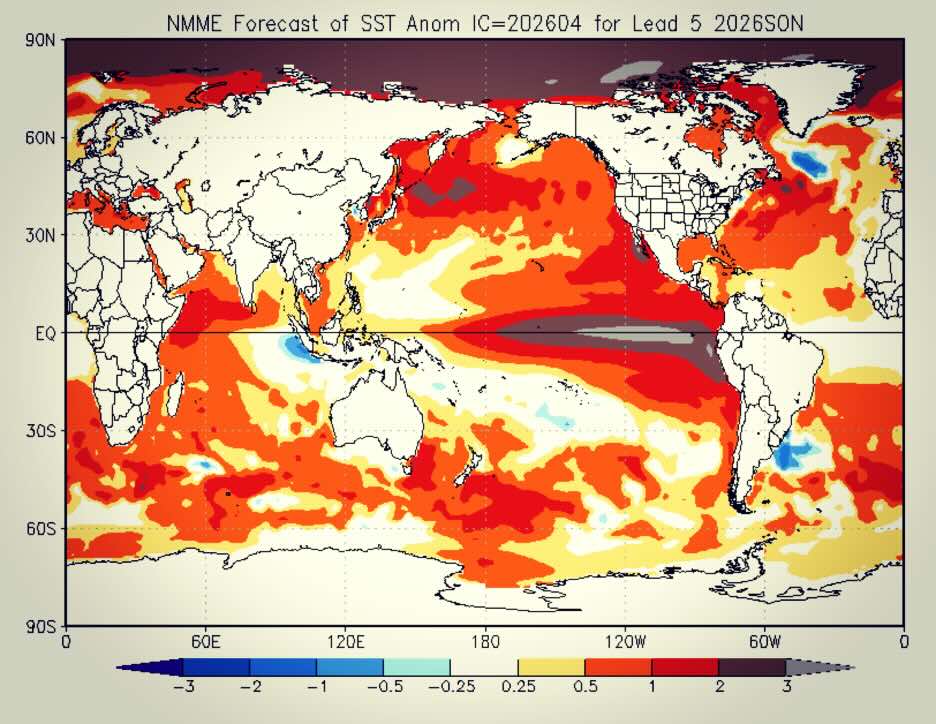
A plume of unseasonably warm water is setting up off the coasts of Ecuador and Peru, extending west across a wide stretch of the central Pacific. It’s a classic eastern-Pacific El Niño configuration—not a central-Pacific (“Modoki”) one—and how it develops over the coming months will shape winter 2026-27 across much of the Northern Hemisphere …
Your loyal guide to a changing world.
Membership with The Signal means exclusive access to premium benefits:
* In-depth feature interviews with our network of contributors
* The despatch, our weekly current-affairs and cultural-intelligence briefing
* Early access to new products, including print extras
It also means vital support for a new, independent venture in current affairs.
New music
‘Sidestep—Edit’
Now to London for some spiky indie rock from the four-piece World News. The lyrics evoke frustration and conflict—wasted days, abandonment, accusation. But the pre-chorus builds, and the chorus pays off.