The only suspect

Recently: How’s the green transition going? Thea Riofrancos on the politics the technology can’t solve. … & The Iranians couldn’t win the war—so how’d they win the terms?
Today: In Bogotá, a one-point defeat turns into a demand to recount the vote. … In Moscow, the Kremlin starts pricing up fuel imports as its refineries burn. … &c.
For members: What’s extreme heat do to you? Noah Diffenbaugh on the hidden costs of a warming world. … & The rain belt’s moving north, as millions cross their fingers.
+ New music from The Avalanches x Jamie xx …
Of all countries
Sunday’s presidential runoff in Colombia went to the wire. The far-right lawyer Abelardo de la Espriella beat the leftist senator Iván Cepeda by a single point—49.66 percent to 48.70—with nearly every ballot counted. By Monday, the outgoing president, Gustavo Petro, whose side had lost, had named the intruder. The IP addresses on several of the National Registry’s servers—the body that counts Colombia’s votes—had changed, he wrote; outsiders had breached the software and keyed in results: “The only entity in the world capable of doing that is the State of Israel.” He gave no evidence, said he’d take it to the judges later, and called for a full recount. Colombia’s attorney general, with the count past 99 percent, said there was no sign of fraud whatsoever.
So why Israel, you might wonder?
The accusation isn’t as wild as it sounds—which is the trouble with it. Petro broke off relations with Israel in 2024 over the war in Gaza and had been the Israeli government’s loudest critic in the hemisphere ever since; De la Espriella is a hardliner whom U.S. President Donald Trump had endorsed—and Israel’s foreign minister rushed to congratulate. There’s also the issue of private Israeli firms selling spyware and election-meddling services around the world, which is the only thing that gives “the only entity capable” any credibility as an argument rather than a conspiratorial rant. But absent proof, credible arguments mixed with conspiratorial rants also make Israel the easiest name to reach for. Still, it’s worth noting: Petro had questioned the software’s vulnerability since February, months before either round of Colombia’s elections. He only blamed Israel after he lost, though.

Meanwhile
- Havana changes the rules. Days after Cuba’s National Assembly voted to open the economy to private business and foreign capital, Washington answered. On Tuesday, Secretary of State Marco Rubio sanctioned five entities tied to GAESA, the military conglomerate that controls close to 40 percent of GDP—among them the commercial bank foreign investors depend on and the firm that warehouses the island’s imports. Anyone dealing with them now risks getting cut off from the U.S. financial system.
- Long-range sanctions. Ukraine’s months-long drone campaign against Russian refineries has reached Russia’s own pumps. Gasoline output fell about 25 percent last week, sales limits and queues have spread across the country, and Deputy Prime Minister Alexander Novak has convened an emergency meeting on the shortages. One of the world’s largest oil producers is now weighing a step it had long resisted—importing gasoline to keep its home market supplied.
- The one that didn’t make it. Keir Starmer resigns as Britain’s prime minister, clearing the way for its seventh leader in a decade. … Australians’ trust in the United States hits a record-low 31 percent—just three points above China’s. … Washington clears Iran to sell oil for 60 days, while Tehran denies agreeing to readmit nuclear inspectors. … Serbian prosecutors now claim student protesters faked a panic about a “sound cannon,” an acoustic weapon they’d accused the state of using on them. … A meteorite in the Sahara has proved to be a piece of a moon-sized world that broke apart in the solar system’s first few million years.

Smarter, faster networks for serious teams
For years, enterprise leaders have compromised on connectivity, battling dead zones and rigid networks. Now, T-Mobile for Business is rewriting the rules—introducing SuperMobile, built to transform how your enterprise runs, scales, and secures its data.
Feature
Short fuse, slow mind
What’s extreme heat do to you? Noah Diffenbaugh on the hidden costs of a warming world.

It’s hot this June—almost everywhere in the Northern Hemisphere. The FIFA World Cup is on across North America—players from cooler countries dousing themselves between drills, officials pushing kickoffs later in the day to duck the worst of it—while in Europe, the thermometer is climbing past 40 degrees Celsius. FIFA itself has set heat thresholds for the tournament—points past which refs call water breaks and planners move kickoffs.
But if you’ve ever been in extreme heat, you know intuitively, it doesn’t just wear you out. What else is it doing?
Noah Diffenbaugh has explored the research with us here in The Signal: Exposure to extreme heat tracks with declines in cognition and labor productivity, more workplace injuries, and rising interpersonal and intergroup violence. The threshold the World Cup watches for slowing legs is, Noah says, also where judgment and temper begin to go.
From July 2021, Diffenbaugh on the price of a heat wave …
Weather report
Waiting for the rain belt
13.5127° N, 2.1125° E
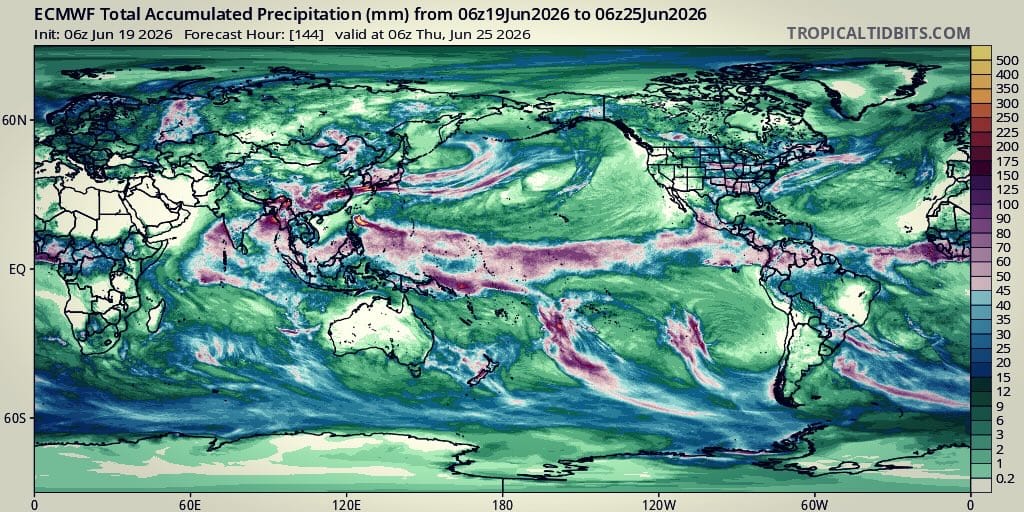
The summer solstice hits the Northern Hemisphere on June 21. As the Sun climbs to its northernmost point, the Hadley circulation intensifies, driving soaking rains deep into the tropics. In 1735, the British lawyer George Hadley codified the circulation to explain the trade winds and the windless doldrums near the equator. On our map, a purple ribbon runs along the equator across the Atlantic and northern South America.
That’s the Atlantic Intertropical Convergence Zone (ITCZ) …
Your loyal guide to a changing world.
Membership with The Signal means exclusive access to premium benefits:
* In-depth feature interviews with our network of contributors
* The despatch, our weekly current-affairs and cultural-intelligence briefing
* Early access to new products, including print extras
It also means vital support for a new, independent venture in current affairs.
New music
‘Every Single Weekend (ft. Jamie xx)’
An interlude on Jamie xx’s 2024 album, In Waves, is now a fully realized song, pairing the London producer and DJ with The Avalanches—arriving at just the right time of year for it.