Leave your phone at home
Recently: What happened to the “public intellectual”? Raymond Geuss on a role that lasted 70 years—and why he won’t really miss it. … & Saudi Arabia, Turkey, and Pakistan have just agreed that an attack on one of them is an attack on all. Now what?
Today: In Chocó, the president who vowed to destroy the armed groups needs them to let aid through. … In Moscow, the Supreme Court strikes the only anti-war party off next month’s ballot. … &c.
For members: Why do temperatures keep rising—even after they cool off? Rachel Cleetus on rising temperatures, billions in damages, and the climate’s uncertain future. … & … Sand from the Sahara is keeping the Atlantic quiet. It won’t last.
+ New music from Overmono …
Permission to enter
An earthquake hit western Colombia at 7:34 on Monday morning, killing at least 181 people and injuring nearly 1,250. The epicenter was San José del Palmar, in Chocó, the poorest department in the country. There are almost no roads; you have to travel by river—as does cocaine, west to the Pacific. Guerrillas and drug traffickers have fought over the rivers for years—and in Chocó, are barring 21,000 people from leaving their villages. The quake cut off two of the department’s river regions, the San Juan and the Baudó. Shirley Hidalgo, who runs World Vision’s operations in Colombia, says both are now inaccessible. Why?
Fallen bridges are part of it—but the way into Chocó belongs to armed groups, and aid workers here negotiate passage with them. The United Nations counted 416 restrictions on humanitarian access last year, 13 percent more than in 2024. The people they have to negotiate with keep changing. Etienne Malingrey, Colombia director of the International NGO Safety Organization, which advises aid agencies on security, says the groups fragment faster than anyone can work out who is in charge: Commanders turn over fast, the fighters are very young, and the chains are unclear. Colombia’s new president, Abelardo de la Espriella, just took office on August 7, promising a military offensive against these armed groups—four days before the quake. One aid worker says the groups are apprehensive and already letting fewer people through. At the checkpoints, they’ve been going through aid workers’ phones, so the teams are now going in without them—a phone being a list of everyone you’ve talked to.

Meanwhile
- Out of production. On Monday, U.S. President Donald Trump signed an order splitting the childhood MMR vaccine—measles, mumps, and rubella—into three shots at separate visits. He says fewer shots at a time give children “gold-standard” protection, in line with peer countries. There’s been no licensed single-antigen version of any of the three in the United States since Merck stopped making them in 2009. Washington doesn’t set school vaccination requirements, though. The order tells the Justice Department to sue the states that do.
- ‘Signs of extremism.’ Russia’s Supreme Court on Monday struck Yabloko, the only party in next month’s parliamentary elections calling for an end to the war in Ukraine, off the ballot. The Central Election Commission had registered it unanimously 12 days earlier. The suit came from Rodina, a nationalist party, which alleged foreign funding and said Yabloko’s call for peace showed signs of extremism. Russians vote from September 18 to 20.
- Running 2,400 years late. Drones are torching Russia’s biggest petrochemical plant, 2,200 kilometers into Siberia; Ukraine hasn’t claimed anything. … Iran’s new supreme leader puts a former Revolutionary Guards spy chief in charge of the Basij, the militia that crushes protests. … Houthi missiles kill 11 at Mokha, a Yemeni port, and reportedly burn a Saudi refinery. … In Jharkhand, India, police turn water cannons on students demanding a rerun of a government-jobs exam they say officials leaked. … & Greek divers have found a ship that sank off Andros around 400 BC, carrying 600 jars of wine or oil.

A lot of people put off life insurance because they assume it’s expensive. The truth is, most of us overestimate the cost. Through Ethos, you can get coverage for around $54 a month*—and you can get approved in as little as 5 minutes.
* Sample rate: 10-year term $1M life policy for a 40-year-old healthy, non-smoking male.
From the files
The heat beneath
Why do temperatures keep rising—even after they cool off? Rachel Cleetus on rising temperatures, billions in damages, and the climate’s uncertain future.
The world’s oceans just had their hottest July ever recorded. The sea outside the polar regions averaged 20.96 degrees Celsius, with the fiercest heat along the Atlantic and the western Mediterranean—where a buoy off Mallorca read a barely believable 32 Celsius. On land, western Europe has come through its hottest June and July on record, with wildfires across the Mediterranean and a fifth heat wave now building over a continent that keeps breaking its own marks. The Pacific’s strengthening El Niño is adding to it. But El Niño is a passenger, not the driver. … See “Dust in the engine,” below.
Why is this happening?
Rachel Cleetus laid out the mechanism here in The Signal. El Niño turns the heat up in a given year, she says, but the baseline it’s adding to climbs higher all the time, as greenhouse gases trap more energy—so each cycle peaks hotter than the last. The ocean absorbs most of this heat—which is why marine heat waves and record sea temperatures are among the clearest signs of a warming planet. And that doesn’t simply reverse when the summer ends; it commits the world to melting ice and rising seas for centuries.
From September 2023, Rachel Cleetus on the summer you can feel—and the deeper changes you can’t …
Weather report
Dust in the engine
14.9315° N, 23.5125° W
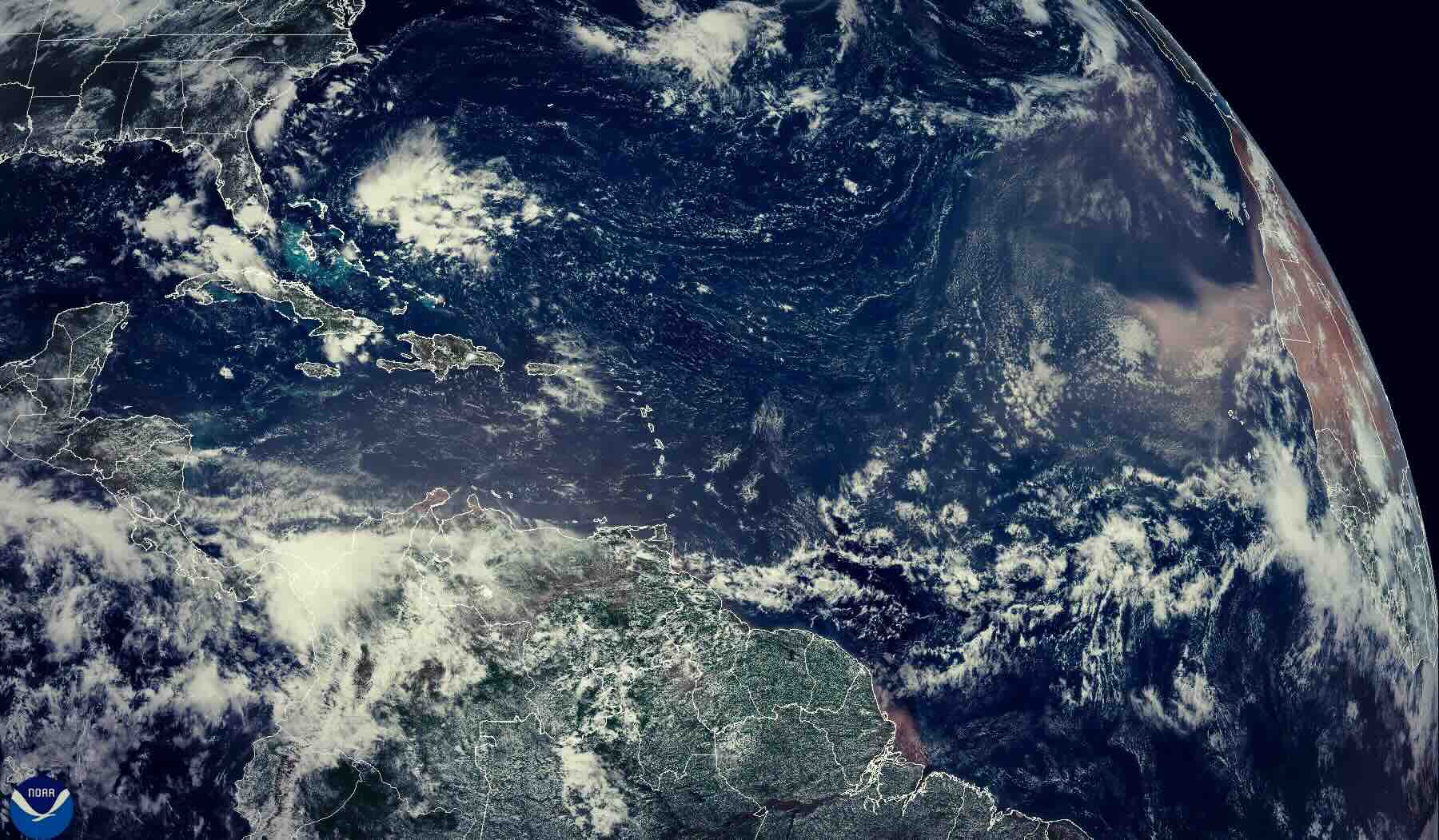
One of the lesser-discussed factors in tropical-cyclone formation begins thousands of miles east of the Atlantic hurricane belt, in the Sahara Desert. Each summer, powerful African easterly winds lift enormous quantities of fine mineral dust high into the atmosphere, creating the Saharan Air Layer (SAL). That dry, dusty air mass can then travel westward across the tropical Atlantic, sometimes reaching the Caribbean and the Gulf Coast of the United States …
Your loyal guide to a changing world.
Membership with The Signal means exclusive access to premium benefits:
* In-depth feature interviews with our network of contributors
* The despatch, our weekly current-affairs and cultural-intelligence briefing
* Early access to new products, including print extras
It also means vital support for a new, independent venture in current affairs.
New music
‘Lockup’
Tom and Ed Russell, the Welsh brothers who record as Overmono, released their second album, Pure Devotion, on August 7 via XL Recordings. The lead track preceded it in May. “Lockup” samples “What a Waste,” by Fast Relief, a Birmingham band from the turn of the 1980s who never put out a single—and left almost no trace until a 2022 compilation of Midlands post-punk featured them. The Russell brothers apparently became fascinated by the scene from reading Simon Reynolds’s Rip It Up and Start Again.