Orwell’s list
Recently: An anti-war party banned from Russia’s elections for copyright infringement? Garry Kasparov on why Vladimir Putin needs his opposition not just beaten but gone.
Today: At the United Nations, Britain’s prime minister accuses Russia of trying to meddle in its 2019 election. … Five weeks before Nineteen Eighty-Four came out, its author sent 38 names to a secret propaganda unit. … &c.
For members: Why does nothing in the United Kingdom seem to work? A.G. Hopkins on the decades of self-inflicted wounds that have hollowed out the British state.
+ New music from Westside Cowboy …
Developments / U.K. & Europe
Yes you, Russia
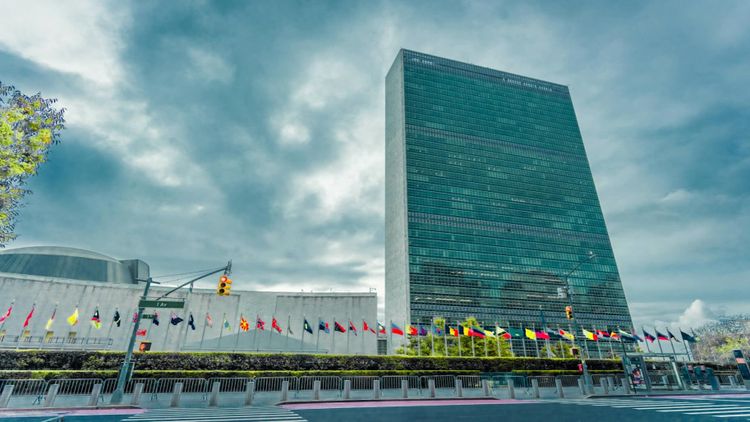
On Tuesday in New York, the U.K.’s Prime Minister Andy Burnham used his first speech to the UN General Assembly to accuse Russia of information warfare. The Kremlin, he says, spends about £1.3 billion a year manipulating media. Its agencies have forged the branding of 28 British organizations, the BBC among them, and tried to interfere in Britain’s 2019 general election. “We have tiptoed around this for too long,” Burnham says, and he’s told the country’s security chiefs to build a National Centre for Information Defence. On Wednesday, the opposition Reform UK leader, Nigel Farage, posted his answer: “Andy Burnham is setting up a Ministry of Truth to clamp down on free speech.”
The run-down feeling
In the same speech, Burnham says Britain has given “too much ground to those who want to run a negative, corrosive narrative about life in Britain.” His defense secretary, Wes Streeting, says the government is “not interested in policing domestic political dissent.” Silkie Carlo, who runs the civil-liberties group Big Brother Watch, says earlier government counter-disinformation units recorded and flagged Britons’ lawful speech. Robert Topinka, who studies digital media and rhetoric at Birkbeck, University of London, says the gloom starts at home: “People are feeling like Britain is run-down.” Russia doesn’t necessarily start these storylines, Topinka says. It finds a point of tension and amplifies it.

Washington’s version
In April 2022, the U.S. Department of Homeland Security set up a Disinformation Governance Board. Critics called it a Ministry of Truth, and the department suspended it three weeks later. Here in The Signal, Monika Richter says the government brought much of that on itself: Many members of Congress learned about the board from an item in a newsletter, and early questions got vague answers. Before that, she says, whenever Washington talked about disinformation, “it’s always been clear that this disinformation came from foreign, adversarial actors”—Russia, China, Iran. The State Department’s office for fighting it had no mandate over anything that started inside the United States. … See “Matters of fact.”
Sent from a sickbed
On May 2, 1949, from a sanatorium bed in Gloucestershire, George Orwell sent his friend Celia Kirwan a list of 38 writers and journalists he considered “crypto-communists, fellow-travellers or inclined that way and should not be trusted.” Kirwan worked at the Information Research Department, which the Labour foreign secretary, Ernest Bevin, had set up the year before, in secret, to answer Soviet propaganda. Five weeks later, Secker & Warburg published Nineteen Eighty-Four in London. The department grew to 390 staff by the mid-1960s. Another Labour foreign secretary, David Owen, closed it in 1977. The public only learned the department had existed the following January—from The Guardian.
Meanwhile
Swedish prosecutors reopen an inquiry into reports of pre-marked ballots in Borlänge, in a general election the center-left won by three seats. … The EU renews its Russia sanctions for three years, minus two billionaires, Alisher Usmanov and Mikhail Fridman. … In France, 14 percent of filling stations run short of at least one fuel as Brent crude tops US$100 a barrel. … A Bucharest court frees Călin Georgescu, the far-right candidate whose first-round win Romania’s Constitutional Court annulled in 2024, pending a fraud case. … Russian drones kill two and wound 41 in Kyiv, hours before Ukraine’s president Volodymyr Zelenskyy speaks at the UN. … & Greek archaeologists find the school where Aristotle taught the young Alexander the Great, stone desks and all.
Thoughts? concierge@thesgnl.com.

Wary of fast fashion?
Shop Congo Clothing Company and
make a difference—in style.
Feature
‘Oh, the empire of course’
Why does nothing in the United Kingdom seem to work? A.G. Hopkins on the decades of self-inflicted wounds that have hollowed out the British state.
In early March, an Iranian-made Shahed drone hit RAF Akrotiri, the Royal Air Force base on Cyprus. The destroyer the Royal Navy meant to send, HMS Dragon, was in Portsmouth for maintenance, and it took three weeks to reach Cyprus. In the meantime, the U.K. relied on its friends, not least the French, for protection. As Arnaud Orain said here in The Signal, so much for “Rule Britannia.”
That’s not Britain’s only high-profile failure of late. “The most spectacular recent blunder is the planned high-speed railway High Speed 2,” the economist Paul Collier said here in The Signal. Planners meant HS2 to link London with the north of England. The government has since cut it back to London and Birmingham, and the line is now expected to cost more than £100 billion and won’t open until 2039. To protect bats near the tracks, HS2 has built a 900-meter tunnel through a wood in Buckinghamshire, at a cost of about £100 million.
Britain’s National Health Service is struggling too. An independent investigation published in September 2024 found the NHS “in serious trouble,” with public satisfaction “at its lowest ever.” “Although I have worked in the NHS for more than 30 years,” wrote Ara Darzi, the surgeon who led it, “I have been shocked by what I have found during this investigation—not just in the health service but in the state of the nation’s health.”
So what’s gone wrong?
Music
‘Dobro’
From Manchester, in the English north, comes the four-piece Westside Cowboy …