Applause in Nuremberg
Recently: Is the West cracking up? Georgios Varouxakis on why a feud over who speaks for democratic civilization shows its staying power. (Open-access, in partnership with the Marlborough House Foundation—see our editor’s note here.)
Today: In The Hague, the International Criminal Court has six months before the sanctions take hold, and its French insurer has already left. … &c.
For members—from the weekend despatch: What happened inside a Siberian plague lab? Standpoints from Svetlana Shipilova, Andrew Weber, and Filippa Lentzos.
+ New music from Greg Freeman …
Developments
Subject to verification
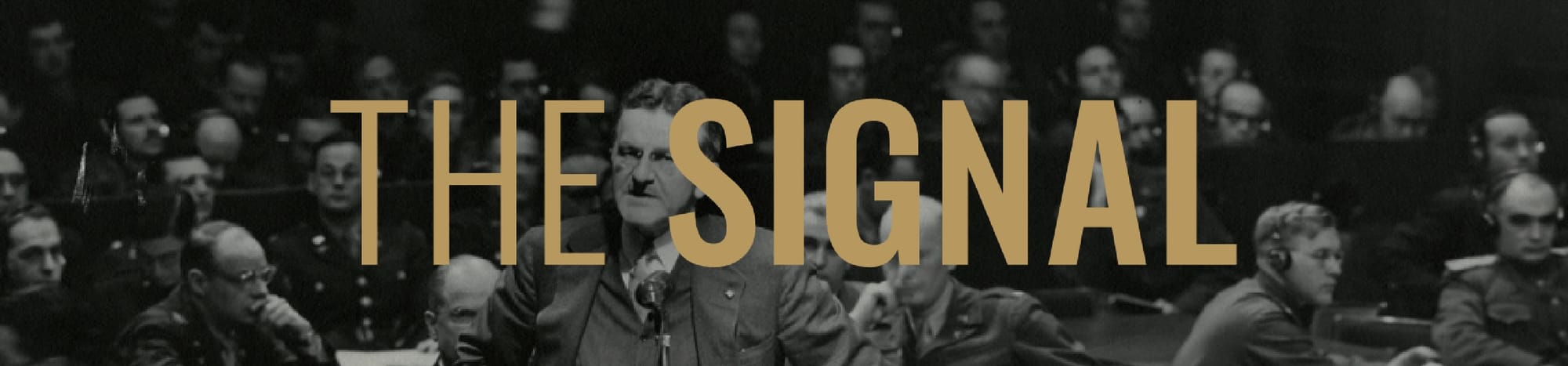
On Friday, the South African jurist Navi Pillay learned she’d won the Nobel Peace Prize while at a forum in Nuremberg, in Courtroom 600, where the Allies tried the leaders of Nazi Germany. The room gave her a standing ovation. “But being a lawyer and a judge,” she said, “I still want to verify this information.” Pillay was one of the first judges of the International Criminal Court, in The Hague. Hours later, U.S. Secretary of State Marco Rubio released a video: “Either the ICC will end its threats, or we will end the ICC.” Washington, which had already sanctioned several of the court’s judges, then went after the court itself. American officials say the move was months in the making.
‘By mutual agreement’
How do you shut down a court? The ICC runs on about €196 million a year from its member states, and like any employer it needs a bank and an insurer. Its health insurer, the French firm AXA, has already gone: The two parted on October 1 “by mutual agreement,” the court says; AXA cited the risk of U.S. sanctions, the Financial Times reports. After 180 days, the new sanctions freeze the court’s assets within American reach and bar American banks and companies from dealing with it. The EU can forbid European firms to comply, but Lize de Kruijf of the Atlantic Council, in Washington, says EU law won’t replace the American business they’d lose. … See “‘So-called international law.’”

Never joined
Rubio’s case rests on consent: “America never joined the court.” But the court claims it can try citizens of non-members for crimes on members’ soil, as with its 2024 warrant for Israel’s prime minister, Benjamin Netanyahu. Rubio warns of prosecutions of American soldiers, though the court has set aside its inquiry into U.S. conduct in Afghanistan. Here in The Signal, Yuan Yi Zhu has pointed out that the court “derives its authority from the states that, by means of the treaty, gave life to it.” Zhu also doubts the court can lawfully make its members arrest Netanyahu. Of the court’s 125 members, five have filed to leave since June—Chad four days after, by its own account, a U.S. official urged it to reconsider its membership. … See “Contempt of court.”
‘The hand of vengeance’
On November 21, 1945, in Courtroom 600, Robert Jackson, a U.S. Supreme Court justice on leave to serve as America’s chief prosecutor, opened the case against Hermann Göring and his co-defendants. Four great nations, “flushed with victory and stung with injury,” had chosen to “stay the hand of vengeance and voluntarily submit their captive enemies to the judgment of the law.” That, Jackson said, was “one of the most significant tributes that Power ever has paid to Reason.”
Meanwhile
The American president says he’ll decide whether to livestream the firing-squad execution of the 2009 Fort Hood gunman, America’s first public one since 1936. … Emirati prosecutors say the Flydubai copilot who took a crash axe to his captain on September 30 meant to fly the jet into Israel’s Ben Gurion Airport. … Ukrainian drones knock out part of a data center that runs Russia’s main search engine, Yandex. … The Saudi-led coalition says it has destroyed 136 Houthi targets after a missile strike on Riyadh’s airport killed three. … & In eastern Kazakhstan, archaeologists dig up a clay bird, with a rattle inside, at a 1,400-year-old settlement.
Thoughts? concierge@thesgnl.com.

Gulf royals have moved billions into global football. Now what?
Read Shadow Play, a new, limited-run print magazine from The Signal.
On sale now in the U.S. and select markets globally.
The weekend despatch
Of unknown origin

In the air
- What happened inside a Siberian plague lab? Standpoints from Svetlana Shipilova, Andrew Weber, and Filippa Lentzos.
From the files
- Why does America cut Moscow slack while threatening France and Germany? Nicholas Mulder on how Washington can still pressure its allies but no longer its rivals.
Features
- Is the West cracking up? Georgios Varouxakis on why a feud over who speaks for democratic civilization shows its staying power.
Books
- What’s the U.S. Federal Reserve really up to? Will Bateman, The Fiscal Fed: How the US Central Bank Funds Government.
Music
- Who’s John Congleton?
- & New tracks from Greg Freeman, Boundary, The Womack Sisters, Lo Moon, & Two Shell.
+ Weather report
- A tropical storm carries five months of rain into the California desert …
Strengthen The Signal.
Become a member, get your bearings, navigate your world.
Music
‘Totaled’
Let’s drop in on Greg Freeman, who spent a decade writing and recording in Burlington, Vermont. Early this year, Freeman left to write songs in the New Mexico desert, before settling in Chicago. Along the way, his Toyota got towed and crushed, a misfortune he grieves in this track from his new album All Set the Bone—recorded by John Congleton in Hollywood.
Who’s John Congleton?