‘The Student List has won’
Recently: Why does American politics seem to have gotten so nasty? Teresa M. Bejan on the difference between good and bad civility in a democracy. (Open-access, in partnership with the Marlborough House Foundation—see our editor’s note here.)
Today: Outside parliament, crowds tear down the ruling party’s tents outside parliament, and the man who lost blames an “American deep state.” … &c.
For members—from the weekend despatch: The U.S. Federal Bureau of Investigation says an engineer hid a recorder in the conference room where his bosses meet government officials—and now his own government wants to pay whatever it takes to get him out of jail. Why? … What’s happening on the streets of Paris, Milan, and Tirana? Standpoints from Plamen Monowski, Michele Serra, and Noah Smith. … & Is Iran behind the Houthi attacks on Saudi Arabia? Alex Vatanka on why the Islamic Republic’s allies don’t always do as they’re told.
+ New music from Josh Johnson …
U.K. & Europe
Before the count
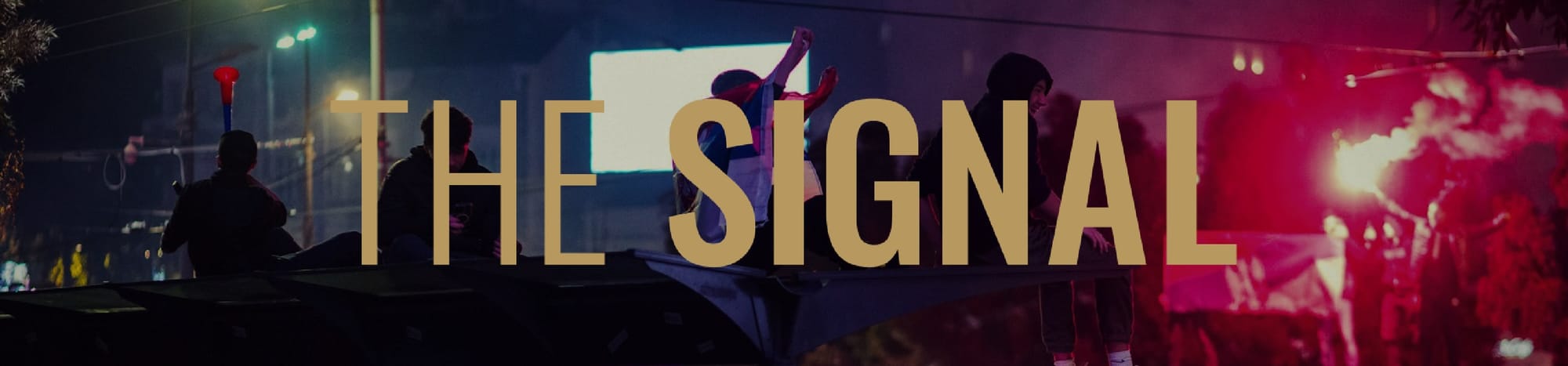
On Sunday night in Belgrade, about an hour and a half after the polls closed, Aleksandar Vučić told his party’s election-night gathering, “The Student List has won.” He’d governed Serbia for 14 years and quit the presidency last month to run for prime minister. He blamed independent media, unnamed European countries, and an “American deep state.” Crowds chanted “Gotov je!”—“He’s finished!”—tore down the fences and tents where his supporters had camped beside the parliament, and set one tent on fire. Dijana Hrka, whose child died when a concrete canopy fell at Novi Sad’s railway station in 2024, told N1 television, “I have been waiting for this moment for two years.”
Into opposition
On Monday night, Serbia’s electoral commission had the Student List on 52.7 percent and 140 of parliament’s 250 seats, and Vučić’s list on 104, more than half a million votes behind. Why did Vučić concede? Nikola Mikovic, a political analyst in Belgrade, compares him with Milo Đukanović in Montenegro, who admitted losing in 2020 and 2023, and Hungary’s Viktor Orbán, who did the same this April. “Like them, he could also promote a narrative of foreign interference,” Mikovic says. Out of power, he argues, Vučić would be a much greater threat to the new government than his opponents were to him. The winners have yet to pick a prime minister.

‘Some chance of winning’
Here in The Signal, Adam Przeworski describes governments that hold regular elections, allow some opposition, and “repress selectively and pretend that they’re democracies.” Following Russian President Vladimir Putin’s lead, he says, “a lot of governments learned that they could keep the trappings of democracy and still stay in power.” Some of them lose anyway: Przeworski points to Poland’s in 2023 and to Orbán’s. In a democracy, he recalls for us, “the current opposition has some chance of winning elections,” and losers accept defeat because they “can reasonably expect that at some point they’re going to win.” … See “‘Keeping up appearances.’”
‘To rest a bit’
On October 6, 2000, the day after crowds stormed the federal parliament in Belgrade, Slobodan Milošević went on television, hands folded, in front of a Yugoslav flag. For 12 days, he’d refused to accept that Vojislav Koštunica had beaten him for the presidency. “I congratulate Mr. Koštunica on his electoral victory,” Milošević said, and added that he intended “to rest a bit and spend some more time with my family and especially with my grandson Marko, and after that to help my party gain force.” The slogan of Otpor, the student movement that had campaigned against him, was “Gotov je!” His minister of information was Aleksandar Vučić.
Meanwhile
Israel’s exit polls give neither Prime Minister Benjamin Netanyahu’s bloc nor his challenger Gadi Eisenkot’s a majority, and Arab-led parties a record 17 or 18 seats. … Luiz Inácio Lula da Silva wins a fourth term in Brazil, and U.S. President Donald Trump says the vote “looked like another rigged election” (see “Early congratulations”). … Cyclone Arnab has come ashore in Andhra Pradesh, on India’s east coast (see “A year to the day”). … The FBI weighs an economic-espionage charge against the former OpenAI engineer Abdulrahman Alfozan (see “‘Saudi needs you more,’” below). … & New dates put early humans at ’Ubeidiya, in the Jordan Valley, at least 1.9 million years ago, hundreds of thousands of years earlier than past estimates—meaning they’d have been among the first humans out of Africa.
Thoughts? concierge@thesgnl.com.

Wary of fast fashion?
Shop Congo Clothing Company and
make a difference—in style.
From the despatch
‘Saudi needs you more’
The U.S. Federal Bureau of Investigation says an engineer hid a recorder in the conference room where his bosses meet government officials—and now his own government wants to pay whatever it takes to get him out of jail. Why?

On September 30, security staff at OpenAI’s San Francisco offices found a thumb-sized recorder, wrapped in toilet paper, plugged into the back of a television in an executive conference room. Nine days later, the FBI arrested Abdulrahman Alfozan, a Saudi engineer at the company, on one count of trying to intercept conversations, which carries five years at most. On Monday, his lawyers asked a federal judge to let him await trial at home. They brought a letter from the Saudi consulate in Los Angeles promising to cover any bond the court set and to issue him no travel papers. The judge, Alex Tse, called the offer “problematic” and kept Alfozan in jail.
Why are the Saudis doing this?
A telephone in the hall
On Saturday, the Louvre will close, and soldiers will deploy alongside police in French cities. The protests that French high-school students began in September, over teacher shortages and run-down buildings, have become weeks of marches and riots. France’s justice minister says police have made 2,700 arrests in the past week, among them a man they suspect of setting fire to the city hall in Limoges, in central France. President Emmanuel Macron blames “seditious” ultra-left groups, and U.S. President Donald Trump blames migrants. In Milan, about 2,000 young people rioted, and Italy’s prime minister, Giorgia Meloni, has sent in 500 troops. Students in Tirana, Albania’s capital, want their prime minister out over corruption, and protesters in Madrid have set up a tent camp over the cost of housing.
What’s going on in Europe?
The gate of tears
Is Iran behind the Houthi attacks on Saudi Arabia? Alex Vatanka on why the Islamic Republic’s allies don’t always do as they’re told.
On Wednesday, a strike on the airport in Dammam killed two people, and the U.S. State Department ordered nonemergency staff out of the country, citing hostilities by the “Iranian-supported Houthis.” Last week, Saudi Arabia’s deputy foreign minister, Rayed Krimly, said the escalation “is encouraged by Iran.” The next day, Iran’s foreign ministry spokesman, Esmail Baghai, answered that the Houthis “act based on their own interests and their own analysis.” Iran mostly stopped attacking Saudi Arabia after April’s ceasefire, but the militias it backs in Yemen didn’t.
In July, a source close to the Houthis told Reuters that Revolutionary Guard officers in Yemen would “control the decision” on closing the Bab al-Mandab. The strait, at the Red Sea’s southern end, has wrecked ships on its reefs and crosscurrents for so long that its Arabic name means the gate of tears. Later that month, the Houthis’ chief negotiator, Mohammed Abdusalam, insisted there was “no closure,” only a blockade “that only affects the Saudi side.” In September, the group promised American diplomats passage for every ship but Saudi ones.
Whose war is this?
Strengthen The Signal.
Become a member, keep your bearings, navigate your world.
Music
‘It Can Be Everywhere’
Josh Johnson co-leads the Los Angeles band SML and is a member of the guitarist Jeff Parker’s ETA IVtet, named for a bar in the city’s Highland Park neighborhood, where the group had a weekly gig …