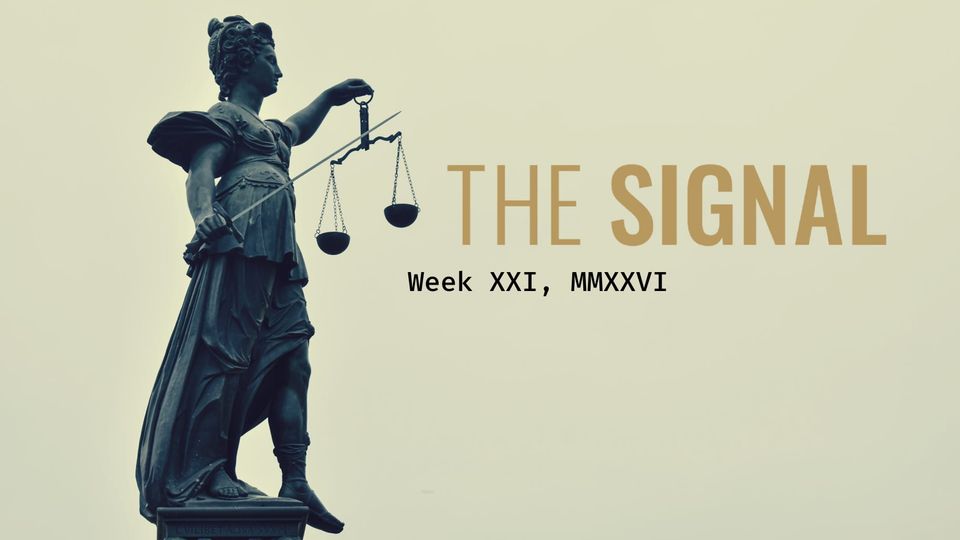
The color of law
Developments
- What’s it taken for Senate Republicans to start breaking with the American president?
- Three Gulf dictators regret they may have to close off your military base. … Where in the world is Mahmoud Ahmadinejad? … & An Ancient Greek hot spot gets a new history.
Features
- How have governments become some of the biggest investors in the global economy? Adam Dixon on a new era of state capitalism.
- Why have Americans lost faith in higher education? Julia Adams and Sarath Sanga on what’s gone wrong—and what universities can do about it.
Books
- What’s an employee? Annie McClanahan’s Beneath the Wage: Tips, Tasks, and Gigs in the Age of Service Work.
Music
- What was the Neue Slowenische Kunst?
- & New tracks from Laibach, Overmono, Hekt x Smerz, Father John Misty, & Ibibio Sound Machine.
+ Weather report
- Europe gets a June preview, while the Gulf gets August in May …
Developments
‘Beyond the pale’
On Monday, the U.S. Justice Department announced a settlement: U.S. President Donald Trump would drop the US$10 billion lawsuit he’d filed against the Internal Revenue Service in January over the 2019 leak of his tax returns; the government would create a $1.776 billion “Anti-Weaponization Fund”—the figure a nod to 1776, the year of the American Declaration of Independence—to compensate people Trump says past administrations wronged.
On Tuesday, the department posted a one-page addendum, signed by Acting Attorney General Todd Blanche, once Trump’s personal criminal-defense lawyer: The IRS is “forever barred and precluded” from pursuing audits or claims against Trump, his family, or their businesses on returns filed before May 18. In congressional testimony the same day, Blanche declined to rule out payments from the new fund to people convicted of assaulting police officers during the January 6, 2021, attack on the U.S. Capitol. The Wall Street Journal’s conservative, and traditionally pro-Trump, editorial board called the fund “rotten.”
By Thursday, Senate Republicans had staged what one of them described to The Hill as a “screaming fest” with Blanche inside the U.S. Senate building; the Republican senator Thom Tillis had called the fund “beyond the pale”; the immigration-enforcement bill Trump had demanded land on his desk by June 1 had stalled. These senators have gone along with a very great deal since Trump returned to office in January of last year.
Why would they break with him now—over this?
- A settlement with no opposing parties. Plaintiff and defendant share a head of state. The federal judge in the case had already questioned whether there was a real adverse controversy between Trump and the agencies he runs. The settlement gives Trump no direct money—just a formal government apology and, via the addendum, permanent immunity from existing audits. Those audits covered returns from years when, by mandate, the IRS should have been auditing the sitting president annually; the former House Ways and Means chair Richard Neal has testified that those audits were never completed during Trump’s first term.
- A fund with no defined recipients. Blanche will appoint a five-member commission to decide who gets paid; Trump can remove any member without cause; the names of recipients and the amounts they receive will stay secret. The criteria are claims of “lawfare” and “weaponization”—terms the document doesn’t define. A former Trump adviser filed the first claim this week. The fund will operate until December 2028, the month before the next presidential inauguration.
- A resistance with a narrow target. Republican senators—Susan Collins, Mitch McConnell, Bill Cassidy, Tillis—are focused almost entirely on the January 6 possibility and the commission’s opacity. Few are challenging the addendum’s bar on future IRS audits or the structural problem of Trump suing himself. They object to visible payments to visible villains, not to the legal architecture the deal builds. The objection might prove durable; it might not. McConnell is leaving the Senate; Cassidy just lost a primary; Tillis has announced he won’t run for reelection.
Here in The Signal, Stephen Hanson describes the second Trump administration as a consolidation phase of patrimonial rule—a form of governance, predating even modern democracy, where the leader treats the state as a family business and doles out state assets to loyalists. Trump has the cadres now, as Hanson says: a cabinet of fealty-pledgers and a Justice Department staffed with people like Blanche, who can build the legal machinery for things prior administrations would never have attempted. As The Signal’s economics editor Justin Callais has put it—and as Andrew Cockburn lays out in a new book, the most consequential forms of corruption in American politics tend to be entirely legal.
What seems different about the Anti-Weaponization Fund is that it makes the government itself a direct and open instrument of corruption, if hidden only by garishly false language. Jared Kushner’s fundraising among Gulf autocracies runs through a private-equity firm. Senator Nancy Pelosi’s stock trades run through a personal brokerage. The revolving door between the Pentagon and private contractors runs through … private contractors. The Anti-Weaponization Fund runs through the U.S. Justice Department, entirely from American taxpayer money, on federal-government letterhead.
That, in part, is what the Senate Republicans are reacting to. The familiar kind of legal self-dealing happens adjacent to government, in private deals and personal investments and post-retirement board seats. This one is happening on behalf of the government—on the record, using a specific sum, with a list of likely beneficiaries. Whether that plainness gives the revolt traction, or whether the patrimonial logic Hanson describes simply absorbs, would appear likely to shape the next 18 months more than any single policy fight will. But the architecture is there either way: The fund runs through December 2028; the bar on auditing the Trump family is, so far, forever.

Meanwhile
- The Gulf brokers a pause. On Monday, President Trump said he’d come within an hour of ordering a major strike on Iran before standing down at the request of the United Arab Emirates, Qatar, and Saudi Arabia. It turns out Tehran had warned the Gulf states, through an Arab intermediary, that any U.S. strike on Iranian power plants would bring retaliation against their energy and desalination facilities. Their leverage: The Saudis cut off U.S. base access during an operation in March until Trump backed down. … See “An hour from the order.”
- Behind the strikes. The New York Times reported on Wednesday that the February 28 U.S.-Israeli campaign against Iran was, from the outset, a regime-change operation: Israel intended to kill Supreme Leader Ali Khamenei and install former president Mahmoud Ahmadinejad in Tehran. Senior Trump officials have since pushed back on the reporting. CIA Director John Ratcliffe called the account “farcical”; Secretary of State and National Security Adviser Marco Rubio, “bullshit”; and Vice President J.D. Vance dismissed the regime-change framing. Ahmadinejad has not been seen since. … See “A regime-change gambit.”
- Before Sparta, the Lakedaimonians. The historian Hans Beck of the University of Münster published a study this week with a striking revisionist claim: Sparta didn’t rise from empty land conquered by Dorians, as the city’s own founding myth holds. It emerged inside a much older world. A few kilometers south of Sparta, a Mycenaean palace at Aghios Vasileios and a sanctuary to Apollo at Amykles—home to a fourteen-meter bronze statue and, beneath it, the tomb of a local hero named Hyakinthos—had for centuries been at the center of a community called the Lakedaimonians. The Spartans, Beck says, inherited it.

Your reading list for a changing world
Browse The Signal’s bookshop—organized into collections that track key themes in our investigations of current affairs: what’s driving the information wars, why societies are fracturing, how power keeps reinventing itself. Contributors’ titles alongside books we've featured in our coverage.
Features
The state’s return
How have governments become some of the biggest investors in the global economy? Adam Dixon on a new era of state capitalism.