A call from Doha
Recently: What do Middle Eastern states want with European football clubs? Sarath K. Ganji on autocratic governments’ ambitious move into the global game.
Today: A critic of one Gulf state, trapped by the country next door. … A year after South Korea’s president tried to impose martial law, his party has been crushed. … &c.
For members: Why would football supporters cheer on dictators buying their clubs? David Goldblatt on identity, loyalty, and what all this money really pays for.
+ New music from Memorials …
Brotherly country
The 2026 World Cup opens on June 11; Canada, Mexico, and the U.S. are co-hosting. Qatar hosted the last one, in 2022. Historically, it had no stadiums or general infrastructure for it, or workers to build them—but it did have a lot of money and brought migrant workers in for the job. More than 6,500 of them died in the country during the decade it spent preparing, according to extensive reporting in The Guardian—a count Qatar disputes.
Abdullah Ibhais managed media for the Qatari organizing committee, and when he pushed it to own the problem instead of hiding it, the committee turned on him. Qatar jailed him for more than three years on bribery and tender-corruption charges—a detention a United Nations panel later called arbitrary—ultimately freeing him only in March 2025. He went home to Jordan, where he’s a citizen, and kept speaking—until a couple of weeks ago, on May 10, when he flew back from a conference in Norway and officers from Jordan’s General Intelligence Directorate stopped him at the Amman airport, questioning him for hours and taking his passport—which they still have—preventing him from attending the Oslo Freedom Forum, a partner organization to The Signal, on June 1.
The reason for all of this still isn’t entirely clear—though one intelligence officer did warn Ibhais, by his account, that he could be prosecuted for “disturbing relations with a brotherly country.” Why would Jordan crack down on one of its own citizens for speaking about Qatar?
For a year after his release, Ibhais had spoken freely. But by May, the stakes had changed for Qatar. Ibhais was due to give sworn testimony on May 30 in a U.S. forced-labor case tied to the World Cup, and he had, by his account, secured backing to sue FIFA and Qatar’s organizers directly. Days before, Jordanian intelligence began interrogating him about Qatar, his case, his contacts at the Human Rights Foundation, which hosts the Oslo Freedom Forum, and demanded he sign a pledge never to discuss any of it. His interrogators, he says, framed his campaign as a threat to Jordan’s relations with Qatar. All of which points toward pressure from Doha—though there’s no direct proof, and Jordanian authorities haven’t officially commented. Ibhais did end up addressing the Oslo Freedom Forum, albeit by pre-recorded video. He’s still in Jordan, in all events, and still without his passport.

Meanwhile
- A ceasefire, by other means. Iranian drones and missiles hit Kuwait’s main airport on June 3, killing one—an Indian worker—and wounding dozens, the first deadly strike on a Gulf state that had thought itself a bystander. The U.S. and Iran traded fire near the Strait of Hormuz on the same day. U.S. President Donald Trump insisted the truce holds—saying in this region, a ceasefire is “when you’re shooting in a more moderate manner”—while privately telling aides he’d end it if Iran kills American troops.
- Clean sweep. South Korea’s President Lee Jae-myung’s ruling Democratic Party swept the country’s local elections on June 3, taking around 12 of 16 mayor and governor races on 61 percent turnout—up 11 points from 2022. South Koreans elected Lee a year ago, in the wreckage of Yoon Suk-yeol’s failed martial-law gambit in December 2024, when he tried to put the country under military rule, and parliament impeached him for it. The vote has every appearance of being a verdict: Lee’s party already held the presidency and the legislature; now it holds most of the mayors and governors too.
- A food fair in Victoria Park. Russia’s June 2 overnight barrage on Kyiv kills at least 22. … Ukrainian drones set a major St. Petersburg oil terminal ablaze. … The U.S. Senate blocks Trump’s bill to make voters prove citizenship with a passport or birth certificate, 48–50, four Republicans defecting. … A Serbian peacekeeper dies near Marjayoun, the seventh UN soldier killed in south Lebanon since March. … In Hong Kong, police take away seven people near the old Tiananmen vigil site—one for holding a single yellow flower—where a state-backed food fair now fills the park on June 4.
Wary of fast fashion?
Shop Congo Clothing Company and
make a difference—in style.
Feature
Front lines
Why would football supporters cheer on dictators buying their clubs? David Goldblatt on identity, loyalty, and what all this money really pays for.
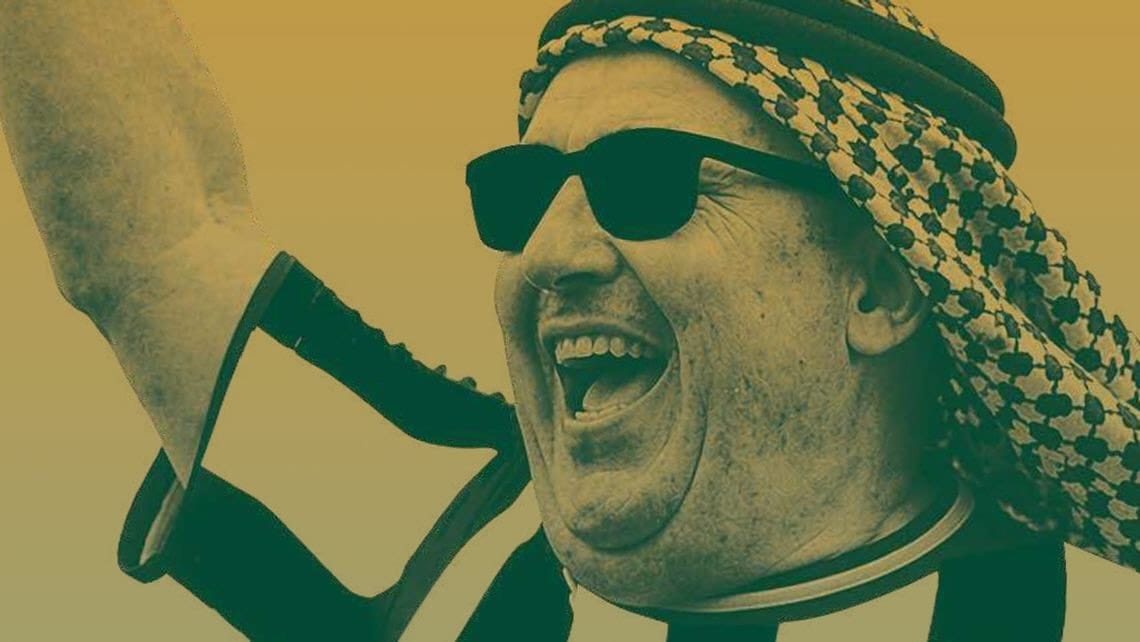
On the evening of October 7, 2021, thousands of Newcastle United supporters gathered outside St James’ Park, the club’s stadium in northeast England. The Premier League had just ratified the sale of the club to Saudi Arabia’s Public Investment Fund. Some supporters wore fake thobes—the long, ankle-length robe traditionally worn by men across the Arabian Peninsula. Others had wrapped tea towels around their heads with ribbon. A chant went up, aimed at Manchester City: We’re richer than you. Parents held their children up to witness what the local papers called a new dawn.
A van drove past the stadium, meanwhile, carrying a poster that read Justice for Jamal Khashoggi. Khashoggi was a Saudi journalist and dissident murdered and dismembered inside his country’s Istanbul consulate three years earlier—on the orders, a U.S. intelligence report later concluded, of PIF’s chairman, Crown Prince Mohammed bin Salman.
The supporters saw the van. They kept singing.
Why?
David Goldblatt is a British sports journalist and sociologist, and the author of The Ball Is Round, on football’s global history, and The Age of Football, on its entanglement with money and power over two decades. Goldblatt says scenes like this have been a long time in the making. A foreign government had just bought itself one of the oldest clubs in English football—130 years of history, rituals, songs, grievances, loyalties, the whole of it. No regulator had blocked the sale. No court had intervened. No ministers had so much as asked any particularly difficult questions. No one had, it seems—apart from the small minority of supporters pointing out that the chairman of their club's new ownership had apparently seen to a critic’s brutal assassination just three years earlier ...
From The Signal’s new limited-edition print extra, Shadow Play.
Your loyal guide to a changing world.
Membership with The Signal means exclusive access to premium benefits:
* In-depth feature interviews with our network of contributors
* The despatch, our weekly current-affairs and cultural-intelligence briefing
* Early access to new products, including print extras
It also means vital support for a new, independent venture in current affairs.
New music
‘In the Weeds’
How about some new British psychedelia? From Memorials, the Canterbury duo of Verity Susman (of Electrelane) and Matthew Simms (of Wire), splicing dub and folk into something unexpectedly catchy.